


 +90 256 612 88 88

Eupalinos Tunnel Visitor Guide: Before You Enter
The first thing to understand from this Eupalinos Tunnel visitor guide is that this is not an archaeological site where you simply walk through the gate, take a few photographs and leave. Narrow corridors, stone steps, damp surfaces and controlled admission mean you should confirm the opening hours, available route and physical conditions before setting out. If you are visiting Samos on a day trip, planning without allowing for your return ferry is particularly risky.
The tunnel passes through Mount Kastro, above Pythagorion. It may look close when viewed from the harbour, but the uphill approach, admission process and time spent underground all need to be considered. Access is relatively straightforward for travellers arriving in Pythagorion. Those arriving at Vathy Port must also arrange transport across the island.
Before shaping the rest of your trip, use our Samos island travel guide to understand the island's different areas. This will help you avoid squeezing the tunnel, a beach, a museum and the Heraion into an unnecessarily rushed itinerary.
Why is the Eupalinos Tunnel worth visiting?
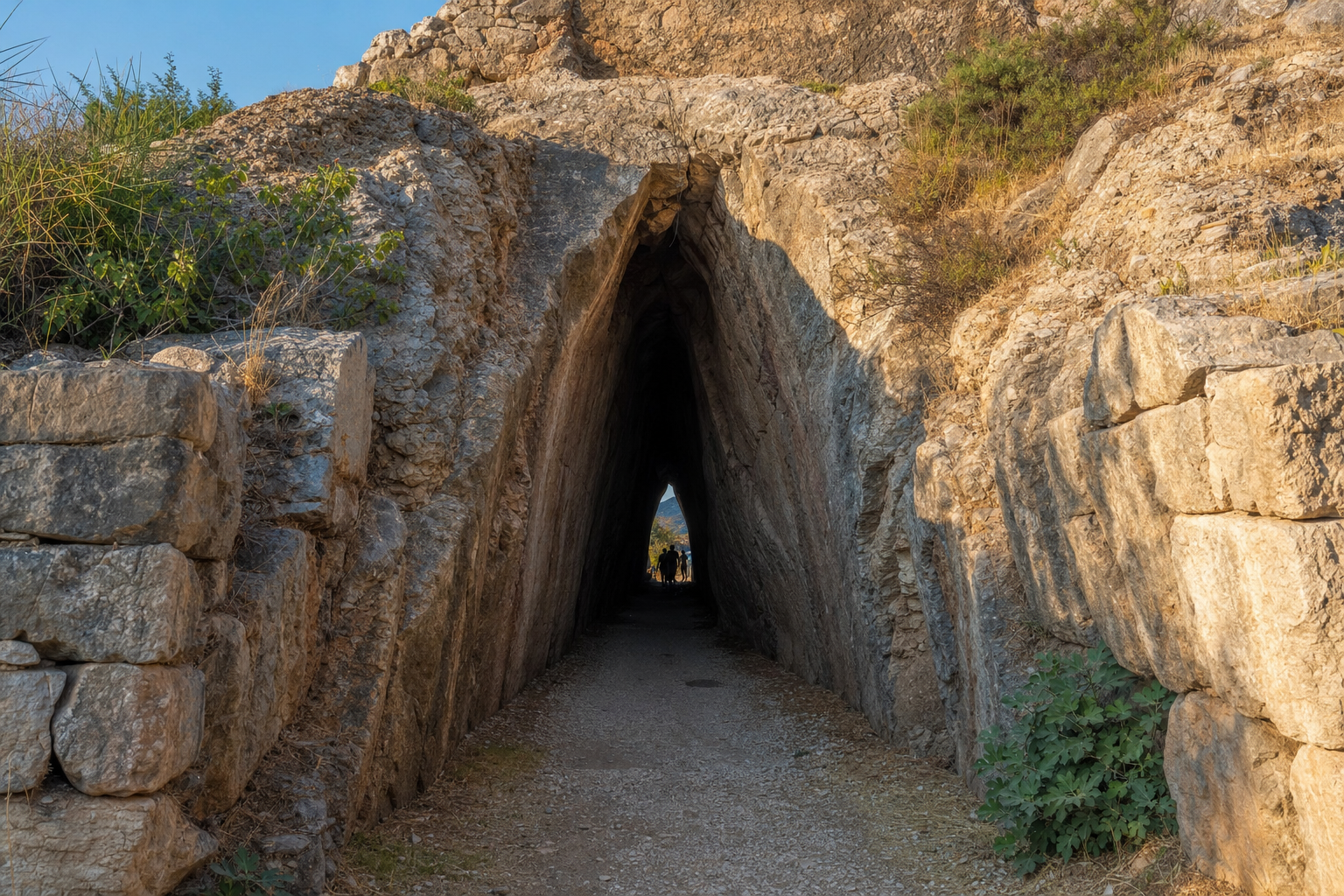
The age of the Eupalinos Tunnel is not the only reason it is remarkable. Its galleries were excavated from opposite sides of the mountain and made to meet underground, an extraordinary engineering achievement in an age with very limited surveying instruments. Once inside, you can read that achievement in the changes of direction, tool marks and exposed stone rather than treating it as an abstract historical fact.
The experience is powerful because you enter a genuine piece of infrastructure built around 2,500 years ago to carry water. You are not looking at a modern museum reconstruction. Even so, the site's importance does not mean that everybody must go inside. Travellers with limited mobility or a strong sensitivity to enclosed spaces should assess the physical conditions carefully in advance.
The tunnel's history and engineering importance
The tunnel was designed in the sixth century BC by Eupalinos of Megara during the rule of Polycrates on Samos. Its main purpose was to carry water safely from a spring north of the mountain to the ancient city. The main gallery, approximately one kilometre long, was excavated from both ends, with the teams meeting inside the mountain. Mentioned by Herodotus, it remains one of the ancient world's most notable works of hydraulic engineering.
The main passage and the water channel did not perform the same function. The corridor allowed people to carry out the excavation, while a separate channel beside or below it conveyed water at the required gradient. Some deviations along the route may look like mistakes. In fact, several were calculated changes of direction intended to increase the chances that the two teams would meet.
Its place within the UNESCO site
The Eupalinos Tunnel forms part of the Pythagorion and Heraion UNESCO World Heritage Site. The ancient urban fabric, harbour and engineering remains of Pythagorion are considered alongside the Sanctuary of Hera in a shared historical setting. Treating the tunnel as an isolated cave visit therefore misses its role in the life and survival of the ancient city.
If time permits, visit the Archaeological Museum of Pythagorion or the remains around the harbour first. This makes it easier to understand the city served by the water system. You can compare other archaeological and natural stops in our guide to places to visit in Samos.
What should you confirm before visiting?
Eupalinos Tunnel tickets, the route open to visitors and the final admission time can change by season or according to operational conditions. Do not assume that prices quoted in an old blog post are still valid. Shortly before your trip, check announcements from the official archaeological site under the Greek Ministry of Culture and confirm local ticket office information.
From October into spring, it is particularly unwise to assume that summer arrangements remain in force. Anyone planning a visit as of 13 October 2026 should reconfirm the schedule because this is a seasonal transition period. Ferry timetables and archaeological site opening arrangements may change independently of one another.
Current opening hours and closed days
Eupalinos Tunnel opening hours can depend on the season, public holidays and staffing arrangements. The hours displayed by a mapping application are not sufficient confirmation on their own. Ask about the last admission time as well as the opening hours. Arriving shortly before the ticket office closes does not necessarily mean you will be allowed to enter.
Your checklist should include the date, day of the week, route currently open, last admission and ticket office hours. If the site is closed on the morning of your ferry arrival, have a backup plan involving the Pythagorion museum, the Heraion or the waterfront.
Ticket and reservation conditions
Admission may involve tickets sold on site, allocated entry periods or limits on visitor numbers. Waiting is possible because of group size and underground safety requirements. On busy summer days, knowing the admission fee is not enough. You should also ask whether advance booking is required or available.
If you believe you qualify for reduced or free admission, carry documentation showing your age, student status or other eligibility. Entitlements and accepted documents can change, so the decision depends on the current rules applied at the ticket office. Your ferry ticket does not include admission to the tunnel.
Possible restrictions due to weather or maintenance
Although the tunnel is enclosed, heavy rain, accumulated water, technical maintenance or safety inspections can affect admission. On a very hot day, the exposed uphill approach may be more demanding than the interior. Do not disregard the possibility of a temporary closure, especially if your itinerary depends on a window of only a few hours.
Site staff may close one section, shorten the route or admit groups at intervals. Avoid building your entire day around one entry time without official confirmation. If the tunnel is closed, returning to central Pythagorion is relatively easy.
How to get to the Eupalinos Tunnel
Your starting point matters when working out how to get to the Eupalinos Tunnel in Pythagorion. Ferries can arrive at two different ports on Samos, so seeing only the island's name on a booking is not enough. Our comparison of Vathy and Pythagorion ports can help you choose the more practical arrival point for a day trip.
Getting there from central Pythagorion
Pythagorion harbour and the tunnel entrance are not at the same elevation. You can walk from the centre, but the route climbs in places and feels longer under the summer sun. For an average walker, allowing around half an hour each way for navigation, the slope and brief pauses is a cautious approach. This is an estimate, not a guaranteed journey time.
If you walk, do not rely solely on your phone's map. Follow the signs for the archaeological site. Early morning is generally more comfortable than the midday heat. Although the return to the harbour is downhill, you still need to allow separate time for shopping, refreshments or lunch.
Transport options from Vathy Port
Vathy is the island's main town and a port on the north eastern coast, while the Eupalinos Tunnel is near Pythagorion in the south. Travellers arriving at Vathy therefore need a bus, taxi or hire car to cross the island. Do not calculate the journey from distance alone. Leaving the port, finding a vehicle, waiting and arranging the return connection all add time.
If you plan to use a local bus, confirm the return service as carefully as the outward journey. Frequency can vary by season and day. On a day trip, a missed connection is more serious for your return ferry than for your tunnel admission. Our guide explaining how to get to Samos provides broader information about ports and island connections.
Planning for a car, taxi or walk
A hire car provides flexibility if you want to combine the tunnel with the Heraion or another stop on the south coast. Remember that there may still be a short walk from the parking area to the entrance. Collecting and returning the vehicle, completing paperwork and dealing with fuel also take time, particularly on a day trip.
If you use a taxi, discuss the return rather than arranging only the outward ride. An available taxi may not be waiting at the entrance during busy periods. Walking is reasonable for active travellers staying in Pythagorion, but the incline can be decisive for anyone with mobility difficulties, even though the distance appears short.
What to expect inside the Eupalinos Tunnel
A Samos Eupalinos Tunnel visit is not a broad, level underground walk. Depending on the route being offered, you may encounter narrow sections, stone steps and passages with reduced headroom. Following staff instructions is essential both for safety and for allowing groups moving in the opposite direction to pass.
Narrow passages, steps and floor conditions
The stone surfaces are rough. The floor may be damp or slippery on some days, while the steps are not as regular as a modern staircase. Handrails may be available in certain sections, but do not expect the same level of support throughout. Keeping your hands free will help with balance.
A large backpack can obstruct both you and the person behind you in a confined passage. Move steadily and maintain space from the visitor in front. Never attempt to enter a separate gallery or cross into a closed section away from your group.
Temperature, humidity and lighting
The tunnel feels cooler than the outside air, even in hot weather. Humidity can make the difference more noticeable if you enter in clothes damp with perspiration. Carrying a light extra layer is useful even during summer. In autumn, consider both the wind outside and the cooler underground temperature.
Lighting is installed for visits, but the atmosphere remains dim and shadows fall across the stone. Follow staff instructions rather than keeping your phone torch switched on throughout. Do not assume that flash photography or additional lighting is permitted.
Considerations for visitors sensitive to enclosed spaces
Darkness, narrow passages, restricted turning space and moving along the same route as other visitors can combine to create discomfort. Mild unease is not the same as claustrophobia capable of triggering a panic attack. If you have experienced serious difficulty in narrow caves or underground structures before, ask staff about the route before purchasing a ticket.
Once a group has started, it may not be possible to leave immediately from every point. There is no need to enter simply to prove that you can. Exploring the archaeological surroundings and visiting Pythagorion can still provide a worthwhile understanding of the site.
How long should you allow for an Eupalinos Tunnel visit?
Eupalinos Tunnel visit duration is not limited to the minutes spent underground. Include transport from the centre, buying or collecting tickets, waiting for a group to start and returning afterwards. A day visitor setting out from central Pythagorion should reserve a flexible block of at least a few hours.
Allowing time for admission and waiting
Do not assume you will enter as soon as you reach the ticket office. Where controlled group admissions are in use, you may need to wait for the next available period. Allowing at least 30 minutes of extra waiting time can prevent a small delay from disrupting the rest of your plans.
Do not treat passport control as part of the time available for the tunnel. Ferry passengers must be at the port at the time specified by the carrier. A queue at an archaeological site is not an acceptable reason for arriving late at the ferry terminal.
How the available route affects duration
The visitor route may vary according to operational conditions. A short section and a more extensive route will not require the same amount of time. Ask about the current route length and approximate time underground when booking or at the ticket office.
The pace of the group also matters. If some visitors need to move slowly on the steps, the tour may take longer. When your ferry departure is close, ask whether a shorter option is available rather than automatically choosing the longest route.
Combining the tunnel with Pythagorion
After the tunnel, you can return to the harbour to see the statue of Pythagoras, archaeological traces along the waterfront and the Archaeological Museum of Pythagorion. Do not assume the museum and tunnel share the same opening days. Allow for restaurant service time if lunch is part of your plan.
For most visitors, the Eupalinos Tunnel, central Pythagorion and the Heraion make a sufficiently full day. Adding areas such as Kokkari or Potami can leave you spending more time in a vehicle than at the places themselves. Use our overview of the highlights of Samos to decide what matters most.
What should you wear and bring?
Advice on what to wear in Eupalinos Tunnel is based on safe movement rather than appearance. Lightweight clothes chosen for hot harbour weather may feel cool underground. Footwear is an even more important decision than clothing.
Grippy shoes and layered clothing
Wear supportive walking shoes with soles that grip. Smooth sandals, loose flip flops and high heels are unsuitable for irregular stone steps. The tunnel is also not a sensible place to test a new pair of shoes that has not yet been broken in.
A lightweight shirt or easily removed layer over a thin top may be enough. In October, the morning ferry, exposed uphill walk and cool tunnel can produce three distinct conditions. For more seasonal advice, our Samos October packing list is a practical starting point.
A small bag and essential items
Choose a compact bag that stays close to your body rather than a large shoulder bag that swings as you walk. Water, identification, a means of payment, necessary personal medication and a light layer should be sufficient. Eat and drink before admission rather than planning a food or water break inside.
- Closed shoes with non slip soles
- A light, easy to carry extra layer
- A small backpack or waist bag
- Passport and necessary travel documents
- A fully charged phone
- Your return ferry details
Taking a large suitcase uphill to the archaeological site is impractical. Do not head directly from the port to the tunnel without first confirming that suitable luggage storage is available.
Photography and visitor rules
Rules covering photography, video, flash, tripods and professional equipment may change. Read the signs at the entrance and ask a member of staff. Stopping suddenly for a photograph in a narrow passage can affect the balance and movement of people behind you.
Do not touch the stone, leave the marked route or cross protective barriers. Hold your phone securely and keep watching the ground. Recording the tunnel is never more important than seeing where you place your feet.
Frequently Asked Questions
Is the Eupalinos Tunnel suitable for children?
Age limits and admission rules for children may depend on the route being offered, so confirm the current policy in advance. Older children who can manage steps safely and are not frightened by darkness or confined spaces may find the visit fascinating. For younger children, independent mobility matters as much as age.
Can people with claustrophobia enter the tunnel?
Some sections may be narrow and dim, with no possibility of turning back immediately at every point. If you have significant claustrophobia or a history of panic attacks, do not enter before discussing the route with staff. Staying outside is the better choice if distress is likely.
Is the tunnel suitable for wheelchairs or pushchairs?
Irregular steps, narrow passages and variable floor conditions mean the standard route may not be suitable for wheelchairs or pushchairs. Accessibility arrangements can change, so request current information from the site management before travelling. Do not assume that a pushchair can be left at the entrance without confirmation.
How long does an Eupalinos Tunnel visit take?
Time underground depends on the route open that day and the pace of the group. Do not rely only on the advertised tour duration, as transport, admission and waiting must also be included. Allow a comfortable period of several hours for a trip beginning and ending in central Pythagorion.
Do Eupalinos Tunnel tickets need to be booked in advance?
Reservation rules and capacity limits may vary by period. Advance confirmation is sensible during busy months or when a restricted route has limited admission. Check the current fee and reservation method through the official archaeological site information.
Plan your visit around the ferry timetable
The key planning rule is to treat your return ferry as a fixed boundary. Your ticket will not protect you from being late because of a site closure, a taxi delay or a long lunch. Confirm the departure and the required port arrival time using the carrier's current information. The Kusadasi to Samos ferry timetable shows the available seasonal schedule.
Planning for arrival at Pythagorion Port
If you arrive in Pythagorion, visiting the tunnel during the morning is usually the more practical approach after passport formalities. This leaves flexibility for lunch and a short walk around the harbour afterwards. Before setting off uphill, confirm the location of your return quay and the time you must be at the port.
Walking early helps you avoid the midday heat. If you use a taxi, include possible waiting time for the return. Should you find a long queue at the site, reassess whether admission is still safe in relation to your ferry rather than continuing with the original plan automatically.
Planning for arrival at Vathy Port
A Vathy arrival requires more careful timing because you must transfer across the island to Pythagorion. Create separate time blocks for leaving the port, travelling to the tunnel, visiting and returning to Vathy. Checking only the outward bus connection is not enough.
If public transport does not fit your tunnel admission and ferry schedule, assess the cost and practicality of a taxi or hire car in advance. When the time budget becomes too tight, choosing the Archaeological Museum of Vathy and the town centre may be safer than forcing in a tunnel visit.
Allowing a safe margin before the return sailing
Do not aim to reach the port just before departure. Even where island traffic appears light, vehicle delays, roadworks, queues or going to the wrong quay can cause problems. Follow the carrier's stated check in and port arrival requirements.
- Confirm the current departure time of your return ferry.
- Add the required port processing time to your itinerary.
- Calculate the journey from the tunnel to the port realistically.
- Leave an extra margin for waiting and unexpected delays.
- Select the visitor route only after assessing the time left.
Passport and visa requirements vary according to nationality, document type and current official regulations. Before travelling, check current requirements, including passport validity, visa status and port procedures, using official sources. Our Samos travel FAQs can also help with general preparation.
First establish which port you will arrive at, then confirm when the tunnel is open. If the physical conditions suit you, pack suitable shoes and leave a generous margin between the visit and your return to the port. Once your plans are clear, you can book your Kusadasi to Samos ferry ticket with Meander Feribot and organise the day around your arrival at Pythagorion or Vathy.