


 +90 256 612 88 88

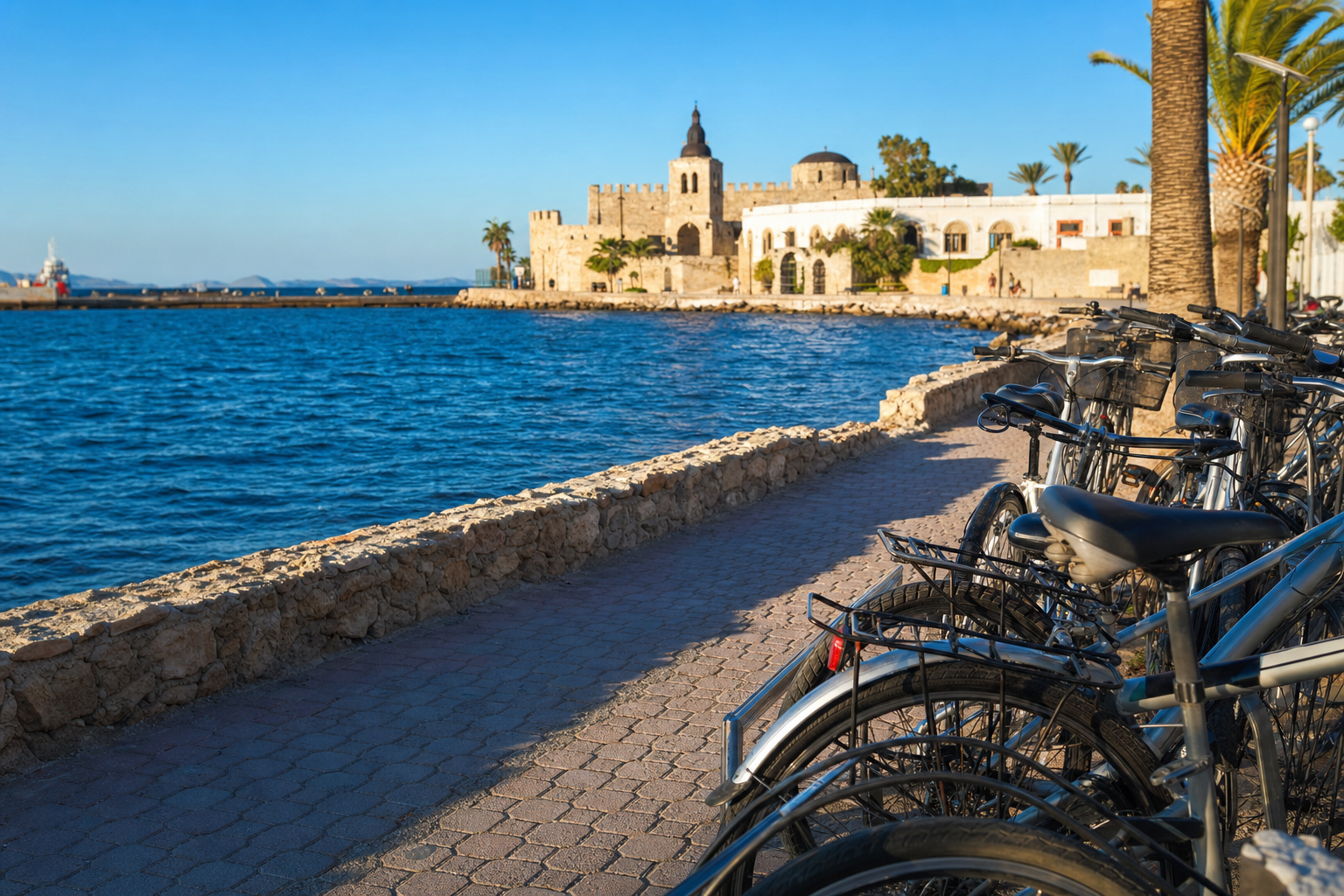
Bike Rental in Kos: 10 Questions to Ask First
Bike rental in Kos is a practical choice if you want to explore beyond the harbour without hiring a car. However, taking the first bicycle you see can make the day unnecessarily difficult. An unsuitable frame, unclear deposit terms or a return time that leaves you rushing for the ferry can quickly undermine an otherwise simple plan. Ten direct questions will help you compare safety, timing and service, not just the advertised price.
Kos Town is fairly approachable for less experienced cyclists, thanks to its level coastal roads and the place cycling occupies in everyday island life. The entire island is not flat, though. The gradient becomes more noticeable towards Asklepion, while fitness, heat and wind matter increasingly on routes into the interior and around Zia. A day visitor should therefore choose differently from someone staying for several nights.
This checklist will help you assess Kos bike rental options according to route suitability, contracts, deposits, insurance, equipment and breakdown assistance. If you are arriving by ferry, begin with the current Bodrum to Kos ferry departures. This makes it easier to set realistic collection and return times.
Who is bike rental in Kos suitable for?
A bicycle suits visitors who want to travel beyond the immediate harbour area but consider a hire car unnecessary. Kos Town harbour, Neratzia Castle, the Plane Tree of Hippocrates, the Ancient Agora and nearby coastal districts can be combined in a relatively compact itinerary. Avoiding the search for parking in the centre is another substantial advantage.
Cycling is not automatically the right choice for everyone. Travellers who have not ridden for some time, tire quickly in hot weather or have limited mobility should be conservative about distance. An electric bicycle can reduce the physical effort, but battery range, bicycle weight and the possibility of a headwind on the return journey still need consideration.
The difference between a day trip and an overnight stay
On a Kos day trip, your usable sightseeing time is shorter than the ferry's total time on the island. Passport procedures, leaving the port, completing the rental agreement, adjusting the bicycle and returning to the harbour all take time. Focusing on Kos Town and the nearby coast is usually more enjoyable and safer than spending the day watching the clock because you chose a distant destination.
With an overnight stay, you can start early, pause during the hottest hours and plan your return around daylight. For a multi-day rental, ask where the bicycle should be kept overnight. An open bicycle rack at your hotel does not eliminate theft risk. Assess the locking requirements together with the insurance conditions.
Assessing distance, roads and fitness
Distance on a map tells only part of the story. Surface quality, traffic, junctions, gradients, wind and stops all change the actual journey. The level roads around Kos Town may be comfortable on a city bicycle, while a rough connecting road might call for wider tyres. Some routes also require you to share the road with motor vehicles.
Reducing your planned distance to suit your normal activity level is often sensible. A ride that takes one hour at home may take considerably longer on an unfamiliar island. Photographs, navigation and swimming stops all add time. Use the Kos Island travel guide to understand the main settlements and sketch out a realistic route.
The first 3 questions for choosing the right bicycle
1. Which type of bicycle suits my planned route?
Tell the rental staff where you intend to go, not merely how many hours you want the bicycle. A conventional city bike may be enough for Kos Town and smooth coastal routes. For longer distances, gradients or mixed surfaces, a trekking bicycle with a wider range of gears may be more comfortable. If you are considering an electric model, ask about its realistic range, assistance levels and current charge.
Do not choose by appearance alone. A heavy bicycle with thick tyres is not safer on every route, just as a light bicycle with narrow tyres is not ideal on rough ground. If you need a basket, check its carrying limit. Leaving a rucksack loose in the basket can affect balance and increase the risk of theft.
2. How will you determine the correct frame and saddle position?
Your height is a starting point, but it is not enough on its own. Frame geometry, inside leg measurement and reach to the handlebars all affect riding position. Sit on the bicycle and take a short test ride. Your knee should not lock completely when the pedal is at its lowest point, and you should not have to tense your shoulders to reach the handlebars.
An incorrectly adjusted saddle can cause knee pain or premature tiredness. Check that any quick-release saddle clamp is secure. As an electric bicycle is heavier, being able to put your feet down safely when stopping is particularly important. If a child seat is fitted, test the bicycle's balance before the child gets in.
3. What checks are completed before handover?
Ask the member of staff to inspect the bicycle in front of you. Test the front and rear brakes separately. The tyres should not be soft or have obvious cuts, and the chain should move through the gears without catching. There should be no looseness in the handlebars, saddle, pedals or wheels. On an electric bicycle, also test the display, motor assistance, battery lock and charge level.
- Squeeze each brake lever and push the bicycle forwards.
- Look for cracks, cuts or embedded objects in the tyres.
- Change through every gear during a short test ride.
- Confirm that the bell, lights and lock work.
- Have existing scratches and damage recorded on the handover form.
Taking a few photographs at collection helps document the bicycle's original condition. Photographs do not replace the rental agreement, however. The stronger approach is to have visible damage written on the form and, where possible, acknowledged by a member of staff.
3 questions about prices and the rental contract
4. What is included in the total rental price?
Bike rental prices in Kos vary according to model, duration, season, equipment and company policy. Instead of asking only for the daily rate, request the total charge in writing. Confirm whether helmets, locks, baskets, child seats, repair kits, second locks or hotel collection services cost extra.
Ask what the company means by one day. It could mean 24 hours, a calendar day or any period ending when the shop closes. Late return charges and extension rates should appear in the agreement. The cheapest advertised option may offer poor value if an adequate lock or breakdown support costs extra.
5. How is the deposit taken and when is it released?
Kos bike rental deposit policies differ between businesses. A shop may accept cash, charge a card or place a pre-authorisation on it. Ask about the amount, currency, refund conditions and the expected release of any card hold. The time your bank takes to display released funds may differ from the time the rental company takes to initiate the release.
Check the agreement for circumstances in which money can be deducted. Late returns, lost keys, missing locks, absent electric-bike batteries and new damage may be treated separately. Inspecting the bicycle with a member of staff at return and requesting confirmation that the rental has closed can reduce later disputes.
6. What are the damage, theft and insurance conditions?
The phrase Kos bicycle rental insurance does not necessarily mean complete protection. Ask exactly which types of damage are covered, what excess applies and what is excluded. Punctures, bent rims, broken phone holders, leaving a bicycle unlocked or keeping it outside overnight may all be subject to different rules.
Find out whether theft requires a police report, how the approved lock must be used and what sort of fixed object the bicycle must be attached to. If you have travel insurance, check whether it covers damage involving a hired bicycle. Where spoken assurances conflict with the written agreement, rely on the written terms and have any unclear clause explained before signing.
The final 4 questions about equipment and roadside help
7. Are a helmet, lock, lights and repair kit provided?
A helmet needs to fit your head and be in sound condition. Check that the straps adjust correctly and that the shell has no deep impact marks. Ask staff to demonstrate the lock. A thin cable lock may not provide adequate protection for a long stop in a quiet location.
If there is any possibility of returning near dusk, test the front and rear lights before leaving. Ask whether reflectors, a bell, spare inner tube, pump and tyre levers are included. Carrying tools is of limited use if you cannot make the repair. In that case, telephone assistance and vehicle recovery are more valuable.
8. Is roadside assistance available after a breakdown?
Ask whether support is available, what hours it operates and which parts of the island it covers. If assistance is described as free, confirm whether recovery, replacement bicycles and transport back to the shop are genuinely included. Some businesses provide only telephone guidance or charge beyond a certain distance.
Save the company's number on your phone and write it on paper. A flat battery could leave you without your digital contact list. Downloading an offline map is also useful for sharing or describing your location. Even so, the risk of waiting for help in an isolated area is rarely acceptable when your return ferry is approaching.
9. Who pays for a puncture or chain problem?
A puncture caused by normal use may be treated differently from damage caused by hitting a kerb. Ask who pays for a new inner tube, a service call or a replacement bicycle. A slipped chain can sometimes be corrected easily, but continuing to pedal forcefully may turn a minor problem into expensive damage.
Move to a safe place and call the rental company before taking action. Loading the bicycle into a taxi or using another repair shop without permission may create reimbursement problems. Never attempt to open an electric motor or battery unit yourself. Learning the procedure at collection takes minutes and can save considerable time later.
10. Do collection and return times fit the ferry schedule?
For a day visitor, this is the most important question. The ferry's scheduled arrival is not the time at which you will necessarily finish border formalities. Similarly, returning the bicycle does not mean you have completed port procedures. Check the shop's opening hours, late return policy and true walking distance from the harbour.
Ferry schedules can change for operational reasons, so do not base the rental on an unconfirmed assumption. Check current outward and return information, then confirm a safe return time with the shop in writing. Before departing Turkey, review the port, ticket and crossing guidance in our useful ferry information.
Evaluating the answers against your Kos itinerary
Once you have answers to all ten questions, do not compare businesses using a single price column. Make separate notes for bicycle suitability, total cost, deposit, damage liability, equipment, support area and return time. An option that costs a few euros more may offer better day-trip value if it includes working lights, a correctly fitted helmet and dependable roadside help.
Short rides around Kos Town
Kos Town's historic centre, harbour, Neratzia Castle area and Ancient Agora can be connected through short rides. Some central streets are busy with pedestrians. Dismount in crowded areas, keep your speed low in narrow lanes and avoid locking the bicycle where it blocks an archaeological site entrance.
A level ride along the coast is often more realistic than extending a day trip towards distant villages. The guide to places to visit in Kos can help you put your stops in a practical order. If you plan to enter museums or archaeological sites, include time for finding secure bicycle parking.
Choosing an electric bicycle for longer routes
Electric bike rental in Kos can be useful for reaching the interior or reducing effort in hot weather. Electrical assistance lowers the physical demand but does not remove risk. Battery capacity, rider weight, assistance setting, wind and gradients all affect actual range. Even if the display shows a full charge, ask the company for a realistic estimate and information about recent charging.
For longer Kos cycling routes, reserve enough battery and energy for the return. Using maximum assistance throughout the outward journey may leave you pedalling a heavy electric bicycle without motor support later. If you are considering Asklepion or the mountain villages, research gradients, traffic and secure parking. Our introduction to Kos Island provides useful geographical context.
Planning around weather, wind and daylight
As of 16 September 2026, summer heat may still be felt on Kos, although the days are shorter than in July. Check the latest forecast immediately before travelling. Midday heat, dehydration and a headwind can make a return journey significantly longer than it appears on a map.
Carry water and plan refills around settlements. Sun protection is not only for the beach. Light-coloured clothing, ventilation beneath your helmet and regular breaks improve comfort. Take lights even if you intend to return before dark, as an unplanned meal stop or minor mechanical problem can delay you.
Practical decision rule: On a day trip, begin returning from your furthest point with a substantial margin before the agreed bicycle return time. Set that margin according to distance, wind, road conditions and port procedures, rather than using an arbitrary number of minutes.
Frequently Asked Questions
Do I need a driving licence to hire a bicycle in Kos?
A driving licence is generally not required for a standard pedal bicycle without a motor. Technical classifications and company conditions may differ for electric models. Ask the rental business to confirm the requirements for your chosen model in writing before booking.
Must I leave an identity document or passport?
Rental businesses may request identification, sight of a document or a deposit, but practices vary. If a shop asks to keep your original passport, ask whether it will accept a copy, card pre-authorisation or another form of security instead. Understand the return procedure before handing over any document.
Can I hire an electric bicycle in Kos?
Yes, rental companies on the island may offer electric bicycles. Availability, models and battery condition vary by date, so advance confirmation is advisable. Ask about battery range, the charger, roadside support and how motor or battery faults are handled under the agreement.
Are child seats and children's bicycles available?
Some companies may provide child seats, trailers or children's bicycles in different sizes, but availability is not guaranteed. At collection, check age and weight suitability, helmet fit and the security of the attachment system. Choose quieter routes rather than busy main roads when cycling with a child.
Can I take a hired bicycle onto the ferry?
First ask whether the rental company permits its bicycle to leave the island or be taken onto a ferry. Then check the ferry operator's bicycle acceptance, reservation and fee rules. Do not bring a hired bicycle aboard without written permission.
Passport and visa requirements depend on nationality, passport type and the rules in force at the time of travel. Check current requirements through official sources before travelling. Eligible passengers travelling via Turkey can also use our 2026 Greek islands visa-on-arrival planning guide as a general preparation framework.
Complete your ferry and bicycle rental plan
Allow time between arrival and collection
Do not assume you will be sitting on the bicycle as soon as the ferry berths. Allow time for passport control, leaving the harbour, walking to the shop, completing the agreement and taking a test ride. First-time visitors can review how to get to Kos and the arrival options before departure.
You may be able to share your ferry number or estimated arrival time when reserving, but ask how long the shop will hold the bicycle after a delay. Make sure your phone works abroad and save the rental location offline. Both steps can prevent wasted time after leaving the port.
Set a safe return time before the homeward ferry
Do not leave the return until the last minute. There may be no fuel to refill, but staff still need time to inspect the bicycle, release the deposit and complete the paperwork. You must then walk to the harbour and finish departure formalities. Follow the port arrival instructions shown on your ticket and provided by the carrier.
If the ferry time changes, notify the rental company as early as possible. Where an out-of-hours key drop is offered, obtain written confirmation of when the bicycle counts as returned and how damage will be assessed. An unattended return may delay the release of your deposit.
Use this 10-question checklist before booking
- Confirm the right bicycle type for your route.
- Test the frame size and saddle adjustment.
- Check the brakes, tyres, chain, gears and lights.
- Request a written list of everything included in the price.
- Confirm the deposit method and release time.
- Read the damage, theft and insurance conditions.
- Inspect the helmet, lock, lights and repair equipment.
- Ask about roadside assistance hours and coverage.
- Clarify who pays for punctures and mechanical faults.
- Set a return time that leaves a safe margin before the ferry.
A Kos day trip by bike can be one of the easiest ways of getting around Kos without a car, provided the route remains modest and the rental terms are clear. To compare cycling with walking and public transport, consult our car-free Greek islands guide.
Choose your outward and return crossings first, then send the ten questions to the rental company and keep its answers. For travel from Bodrum, compare current availability and complete your Bodrum to Kos ferry ticket booking with Meander Feribot, serving Aegean travellers from Kusadasi since 1977.