


 +90 256 612 88 88

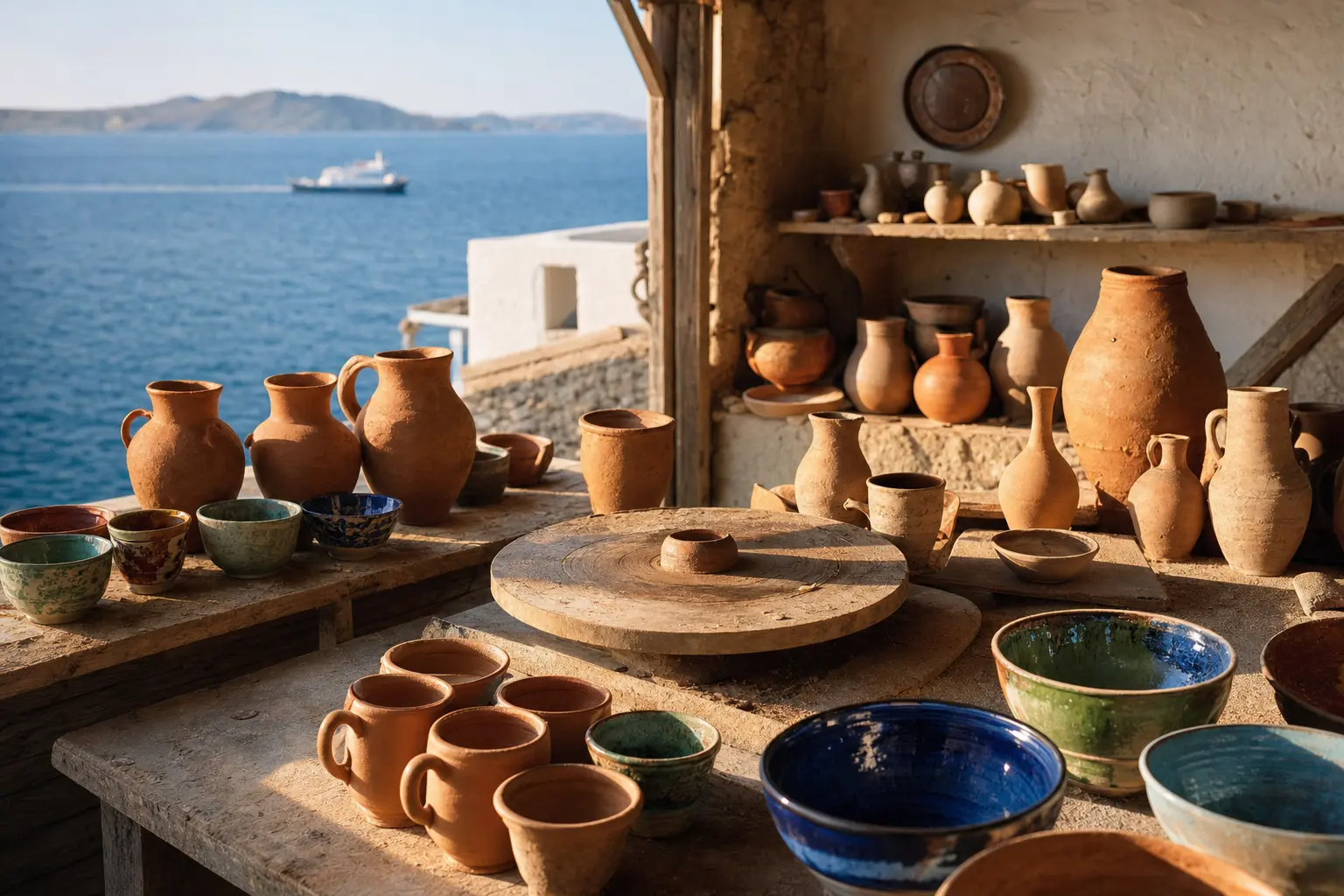
Mandamados Pottery Workshop Guide: What to Look For
This Mandamados Pottery Workshop Guide helps you look beyond the colours on the shelves when you enter a working studio in northern Lesvos. How has the base been finished? Is the handle joined cleanly to the body? Is that fine crack in the glaze a decorative effect, or a fault that could affect use? A sound purchase begins with noticing these details and asking the potter a few clear questions.
Examining Mandamados pottery where it is made is more than an ordinary shopping stop. You may see clay turning on the wheel, newly formed vessels drying on racks and subtle variations across surfaces fresh from the kiln. A working studio is also a production area, however. Confirm visiting hours, ask before taking photographs and keep away from hot equipment or fragile pieces.
Lesvos is a large island, so Mandamados should not be treated as a quick extension of a walk around Mytilene harbour. Check locations, driving times and possible stops in advance. The suggested routes in our Lesvos Island travel guide can help you build a realistic itinerary.
Understanding the Mandamados pottery tradition
The place of local pottery in island culture
The best way to understand Mandamados pottery is to see it as more than decoration. For generations, ceramics were used in island homes to store or serve water, oil, food and other household essentials. Clay vessels were quiet tools of everyday life. Their shapes often reflect practical needs: sitting steadily, fitting comfortably in the hand, pouring liquids with control and being easy to clean.
Contemporary Mandamados pottery workshops do not necessarily reproduce traditional knowledge in precisely the same form. Potters may reinterpret older shapes, make smaller pieces suited to visitors or work with contemporary colours. This does not mean that the tradition has disappeared. Its deeper continuity lies in understanding the material, balancing a form and managing the risks involved in drying and firing.
It helps to place the village within the wider character of Lesvos Island. Olive production, inland villages, coastal towns and the different pace of the island's interior all help explain why its craft traditions are not uniform.
Traditional household vessels and contemporary pieces
A workshop shelf may hold jugs, bowls, plates, mugs, small storage jars, wall ornaments and decorative figures side by side. A traditional appearance does not prove that an object was made using an old method, local clay or the work of one craftsperson. Equally, a contemporary motif does not make a piece any less handmade. Appearance and production method are separate questions.
Decide how you intend to use an item before choosing it. A bowl for olives or meze should not be judged by exactly the same standards as a mug for hot drinks. Surface character may be the main concern with a decorative object. For tableware, the suitability of the glaze, ease of cleaning, comfort of the rim and the workshop's care advice matter more.
From workshop production to the shop shelf
Not every ceramics shop has an active production space behind it. Some retailers sell work by several makers, while other workshops carry out forming, drying, glazing and firing in one place. Ask whether the shelves you see are for production or retail. This simple question may prevent you from touching a piece that has not yet dried.
The process can include preparing the clay, forming it, drying it under controlled conditions, trimming it at the appropriate stage, carrying out an initial firing, glazing and firing again. Exact methods vary between workshops and products. It is better to ask a potter to describe their own process than to assume that every studio follows a standard formula.
Workshop etiquette before you enter
Confirm opening hours in advance
A small workshop may not keep the fixed hours of a chain shop. The potter might be collecting materials, supervising a kiln programme or completing a production stage during which visitors cannot safely enter. The season, day of the week and local holidays can also affect opening arrangements. Shortly before setting out, telephone or use the workshop's current preferred contact channel to confirm that it is open.
In quieter periods, such as late October 2026, the island may feel less busy, but it is unwise to rely on summer opening patterns. If you are driving to Mandamados, consider the return journey in relation to daylight. Travellers using public transport should verify their same day connections separately.
Ask permission before taking photographs or video
Permission to photograph retail shelves does not automatically include the workbench, staff or close details of original designs. Ask before raising your phone or camera. If you intend to publish the images on social media or use them commercially, explain that clearly.
Some potters are happy for visitors to record a piece being formed. Others prefer not to have their concentration or working rhythm interrupted. Do not take a refusal personally. If permission is granted, turn off the flash, stay out of the maker's line of sight and avoid occupying the workspace with a lengthy recording.
Keep a safe distance during production
Ceramics workshops may have pieces of clay, water, electrical equipment and narrow passages underfoot. A kiln can remain hot even when it looks inactive from the outside. Work on drying racks is often more fragile than it appears. If you are visiting with children, point out the boundary between the shop and production areas immediately.
- Do not touch the wheel, tools or wet clay unless the potter invites you to do so.
- Carry bags and coats so that they cannot brush against pieces in narrow passages.
- Keep away from kiln doors, cables and glazing materials.
- Ask before removing an item from a shelf, then hold it with both hands.
Reading the Mandamados pottery process at the bench
Clay preparation and forming
A successful form depends on clay being prepared evenly before it takes shape on the wheel. Air pockets, differences in firmness and uneven moisture can create problems during production. If you see batches of kneaded clay in the workshop, ask what kind of objects they are intended for. Do not assume clay is local from its colour alone. Raw clay, a fired body and a glazed surface can look very different.
When watching a vessel being thrown, notice how the potter's hands control not only the outside surface but also the wall thickness and rim. The clay is first centred, the interior is opened, and the walls are then drawn upwards. A simple bowl formed in a few minutes contains years of experience and muscle memory.
Signs of wheel throwing, moulding and hand building
Handmade does not necessarily mean made only on a potter's wheel. A piece may be formed in a mould, refined by hand, fitted with a separately made handle and decorated with a brush. The production method should be identified accurately before it is used as a judgement of value. Craftsmanship can lie in the surface, joins and firing decisions as much as in the initial shaping.
Wheel marks may appear as faint circular lines inside, a cutting mark underneath or small variations in wall thickness. Hand built work may retain fingerprints or intentional asymmetry. Moulded products are more likely to repeat the same dimensions. No single sign offers conclusive proof. Comparing several similar pieces side by side is usually more informative.
Drying, glazing and firing stages
Newly formed clay does not go directly into a kiln. Moisture must leave it gradually and evenly. Drying that is too fast or inconsistent may cause cracks, particularly around handle joins and areas where thickness changes. Pieces turned upside down or spaced carefully on production shelves show how the maker manages air circulation.
Glaze changes more than the colour of a surface. It also affects how an object can be used. Not every glaze is intended for the same purpose. A decorative wall piece and a bowl designed for food require different considerations. Firing temperature and kiln programme also influence the relationship between the clay body and glaze. Rather than guessing from appearances, ask which methods were used for the particular object.
Details that reveal the potter's intervention
The maker's hand is not visible only through small irregularities. Compressing a rim for the final time, trimming the foot, thinning a handle to suit the fingers and stopping a glaze at a deliberate line are all conscious interventions. A piece with a relatively uniform appearance but a hand finished surface may involve more skilled work than one with conspicuous asymmetry.
The most useful question in a workshop is not Is this handmade? Ask instead: Which stages of this piece are completed here and by hand?
Mandamados Pottery Workshop Guide to assessing a piece
Balance at the base, rim and surface
Place the piece on a flat surface and test it gently. If it rocks noticeably, ask whether this is a design choice or a problem with the foot. The underside should not be sharp enough to scratch furniture. Small working marks on an unglazed foot ring are normal, but projections that catch the skin suggest poor finishing.
Turn a mug or bowl at eye level to inspect its rim. Perfect geometric uniformity is not a reasonable expectation for handmade ceramics. A rim that folds inwards, becomes sharp or feels uncomfortable against the lips can still affect function. For a jug or other liquid vessel, ask about the intended pouring direction and test the empty piece with permission.
Workmanship at handle and body joins
The handle is one of the areas exposed to the greatest stress. Look for open cracks, separation lines or distinct gaps progressing beneath the glaze where the handle meets the body. A thick handle is not automatically stronger. Its proportion, comfort and quality of attachment should be considered together.
Before buying a mug, ask permission to hold it while empty. Check whether your fingers fit comfortably, whether the weight strains your wrist and whether the upper join presses against a finger. Remember that a large mug will be considerably heavier when full.
Glaze variations, cracks and faults
Changes in glaze tone, flowing marks, tiny spots and variations in brushwork can be natural results of small scale production. That does not mean every irregularity should be celebrated as craftsmanship. Sharp bubbles that catch the hand, cracks extending into the ceramic body, pits on a functional surface and chips at the rim deserve closer attention.
Fine networks of lines in a glaze may be intentional in some aesthetics. In other objects, they can indicate a compatibility issue that may develop further. Ask directly about temperature changes, dishwasher use and contact with food. Establish whether the lines are confined to the glaze or continue through the ceramic body.
Intended use and suitability for food contact
A visual inspection cannot prove that a glaze is suitable for food contact. Ask explicitly whether the object was made for serving food, holding drinks or decoration only. Acidic foods, hot drinks, ovens, microwaves and dishwashers may each require a separate answer. If reliable information is unavailable, using the item decoratively is the more cautious choice.
- Decide where and how you plan to use the piece.
- Inspect its base, rim, glaze and joins in good light.
- Compare two or three similar objects for weight and balance.
- Ask the maker about food contact and care instructions.
- Keep the answers with the receipt or a note identifying the product.
Questions for the potter and making an informed choice
The source of the clay and glaze
Do not assume that every ceramic sold in Mandamados is made from clay dug near the village. The material may be local, brought from elsewhere on Lesvos or supplied as a prepared commercial body. None of these origins is automatically a measure of quality. Asking about the source simply helps you understand the product's story accurately.
Go beyond the colour name when discussing glaze. Is it prepared in the workshop or bought ready mixed? What type of use was the surface designed for? A potter may understandably prefer not to share a technical recipe. Respect that boundary, while still requesting clear information about safe use and care.
Forming and firing methods
Ask whether the object was wheel thrown, moulded, slab built or made through a combination of techniques. You can also ask how many times it was fired, at which stage the decoration was applied and why minor colour variations occur. The answers may explain differences in price and appearance between similar objects on the shelves.
The maker and place of production
The person in the sales area may not have made every item. Ask who produced the piece and whether forming and decoration were completed in the same workshop. If it carries a signature or stamp, find out whether this identifies the maker, the studio or a collection. An unsigned object is not automatically factory made, just as a stamp alone does not prove every stage of production.
Care, use and exchange conditions
Before paying, ask about the first wash, hand washing, sudden temperature changes and storage. Obtain explicit confirmation if you plan to use the item in an oven or microwave. You should also understand the workshop's approach to breakages, production faults and exchanges. These details are harder to discuss when you are rushing to catch a ferry, so do not leave your purchase until the final minute.
Packing and carrying ceramics safely
Layered packing for fragile pieces
Good packing first protects the object's own vulnerable areas, then reduces the force of outside impacts. Ask for soft material to be placed between a mug handle and its body without applying pressure. Every item should be wrapped separately. Putting two bowls together without protection between them allows their rims to strike each other during movement.
- Use soft paper or another non abrasive material for the first layer.
- Support handles, rims and projecting decorations separately.
- Add impact absorbing material as a second layer.
- Fill empty spaces in the box without compressing the object.
- Before sealing the box, move it gently to check that nothing shifts inside.
Placing ceramics in a day bag or suitcase
Whenever possible, keep a small or valuable object in hand luggage under your control. Rather than placing it at the bottom, position it between soft layers of clothing and away from hard objects. Water bottles, cameras, shoes and metal accessories should not touch the ceramic.
On the ferry, do not leave the bag in a busy passage or on the edge of a seat where it could fall. If travelling by car, secure the box so that it cannot move around the boot. You can compare vessel types and crossing options on our page covering Ayvalik to Lesvos ferry companies.
Keeping receipts and workshop details
Store the receipt, workshop card and any care note in a separate compartment from the ceramic itself. It is also useful to photograph each object before it is packed. If you buy several pieces, record which care instructions belong to which item. International travellers returning through Turkey should check current official customs rules, personal allowances and declaration requirements before travelling onward.
Frequently Asked Questions
What characteristics is Mandamados pottery known for?
Mandamados pottery is associated with the village's continuing ceramic knowledge, functional household vessels and contemporary interpretations of older forms. No single colour, pattern or shape defines all local production. Instead of guessing an object's origin from appearance, ask about its maker, production place and method.
How can you identify handmade pottery?
Cutting marks on the base, slight dimensional variations, visible brush movement and handles attached by hand can provide clues, but none is conclusive alone. Compare similar products and ask which stages were completed manually. Handmade also does not mean that every irregularity should be accepted as harmless or desirable.
Can you take photographs in the workshop?
Photography depends on the permission of the business and the potter. Treat the retail shelves, production area, members of staff and close design details as potentially requiring separate consent. Do not use flash or interrupt the working process.
How should ceramics be protected on the ferry?
Wrap every piece separately in several layers, support the handle and rim, and fill empty space in the box. Keep the package with you where possible and never place it beneath heavy luggage. Check the latest Ayvalik to Lesvos ferry departures for your return date so that you can reach the harbour without rushing.
Adding Mandamados to your Lesvos travel plan
Allow realistic time for the workshop
Choosing one object from a shelf may be quick. Observing production, talking to the maker, comparing pieces and arranging secure packing require a wider window. If the workshop is busy, the potter may not be able to assist immediately. Avoid squeezing your visit into the final minutes before closing.
Include time for reaching Mandamados, parking, walking through the village and taking a short meal break. Distances on Lesvos can appear modest on a map, but road conditions and journeys through settlements may extend driving times. On a day trip, leave a generous margin for returning to the port.
Complementary stops on an island itinerary
When choosing between villages, coastal settlements and historic sites in northern Lesvos, resist the temptation to fit everything into one day. Compare options in our guide to places to visit in Lesvos. If you have a separate day for the west, the Sigri Petrified Forest guide will help you read the fossil landscape rather than treating it merely as a photograph stop.
If your itinerary focuses on local production, connect the ceramics visit with olive growing and island food. Our notes on Lesvos olive oil tasting explain how to assess quality during a tasting. Thinking about which island foods you might serve at home can also make it easier to choose a useful ceramic bowl.
Final checks before the return journey
Before leaving the workshop, confirm that you have the correct item, that it cannot move inside its packaging and that you have the receipt and care information. Before heading to the port, place your passport, ticket and necessary travel documents in an accessible compartment. Visa rules, entry conditions and document requirements can change, so check current requirements before travelling through official sources and the Lesvos travel FAQs.
Do not leave your route to Ayvalik port, parking arrangements or terminal timing until the final day. Use our guide to getting to the Lesvos ferry ports to plan road and harbour connections. Once you have checked the current sailing and fare options, you can fix Mandamados into the itinerary with confidence. Book the appropriate Ayvalik to Lesvos ferry ticket securely through Meander Feribot.