


 +90 256 612 88 88

Sigri Petrified Forest: How to Read Fossil Details
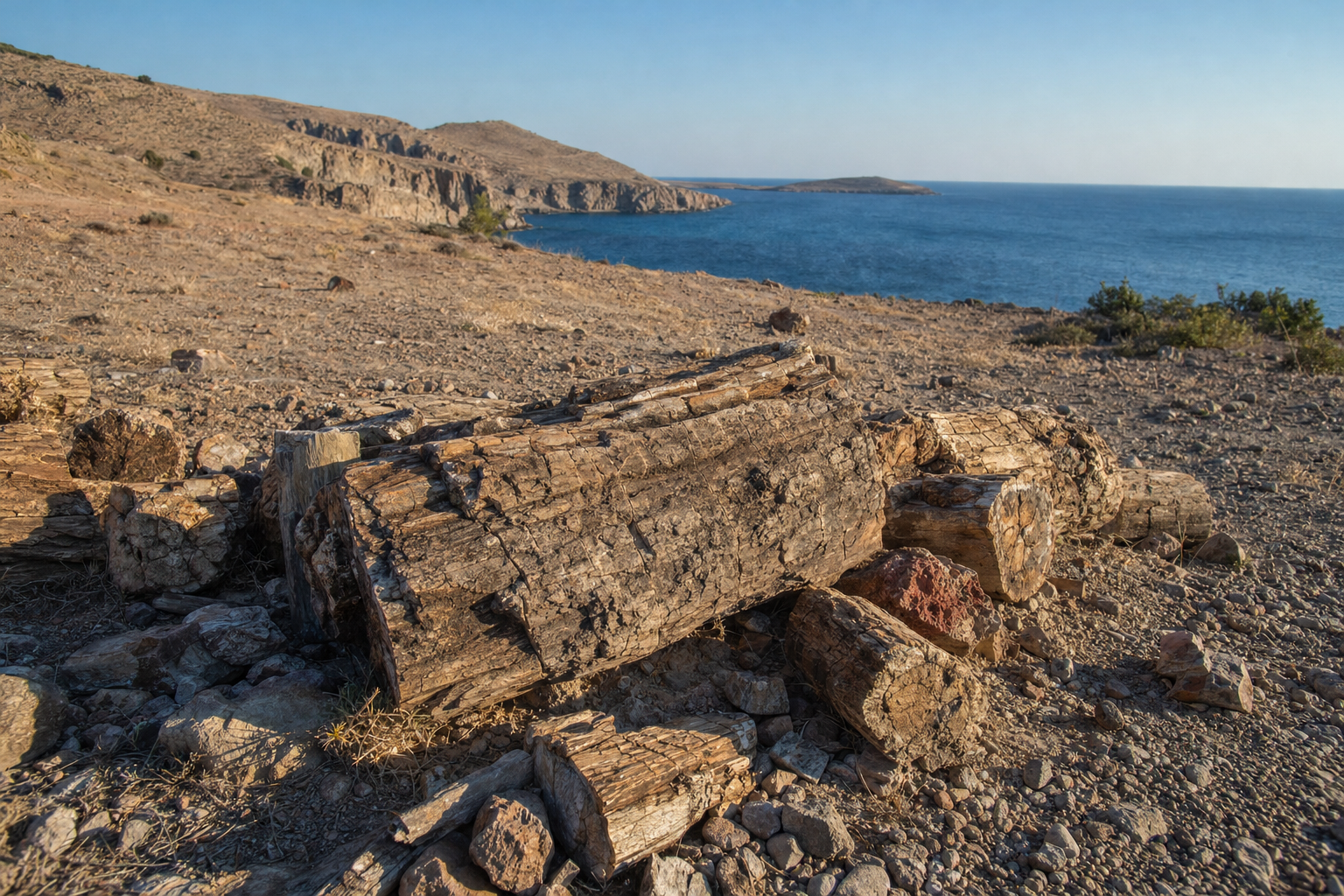
At the Sigri Petrified Forest, the first thing to examine is not a fossil's colour, but the organised traces left by the original wood. Growth rings, bark lines, fibres, branch knots and roots spreading through the ground all help distinguish a fossil tree from an ordinary rock. Once you learn to read these details in the windswept volcanic landscape of western Lesvos, the colourful masses underfoot become legible records of trees that lived millions of years ago.
It is easy to treat Sigri as a scenic stop for photographs. The more rewarding approach is to study each fossil from a distance first, establish the direction of the trunk, then move your attention to the rings in the cross section and the wood grain along its surface. Museum displays help you develop this visual vocabulary, while the outdoor sites let you test it within the volcanic landscape where the fossils formed.
Western Lesvos is a considerable distance from the island's main port city, so transport and visiting time should be planned in advance. If you are combining Sigri with other parts of the island, use these Lesvos itineraries and planning tips to compare possible overnight stops. Giving Sigri sufficient time is far better than squeezing it into an overambitious island circuit.
Why Is the Sigri Petrified Forest Special?
The petrified forest area in western Lesvos is an extensive geological landscape where fossil trees can be understood alongside the volcanic ground that preserved them. This is not simply a collection of small, polished pieces of stone. Upright trunks, fallen logs, root systems and other remains of ancient vegetation offer clues to the spatial arrangement of the former ecosystem.
Sigri's importance does not rest on one exceptionally large fossil. Its real value comes from the number of finds preserved in different positions and conditions. While examining the cross section of a trunk, you may also see volcanic ash and rock layers only a short distance away. The fossil can therefore be read as a trace of life retained within a geological event, rather than as an isolated museum object.
This is what sets Sigri apart from many other places to visit in Lesvos. The castle at Molyvos and the historical buildings of Mytilene tell stories of human settlement. The Lesvos Petrified Forest records a natural process that began far earlier.
The connection between volcanic activity and fossilisation
About 20 million years ago, intense volcanic activity covered the forested environment with ash and other volcanic material. Rapid burial reduced the wood's exposure to air and restricted the usual process of decay. Over time, mineral rich water moving through the volcanic deposits reached the buried tree tissue.
It is important not to imagine that an eruption instantly turned the trees into stone. Volcanic activity created the conditions for burial, while the circulation of mineral bearing water contributed to a much longer process of petrification. The ash tuffs, volcanic rocks and eroded slopes visible today are all parts of the environment in which the fossils developed.
The main difference between petrified wood and ordinary rock
An ordinary rock may have irregular fractures, rounded edges and bands of colour. Petrified wood, however, preserves patterns that repeat the biological architecture of a tree. Parallel fibres, concentric growth rings, an outer bark boundary, branch connections and sometimes remarkably fine, cell like textures may all support one another within the same specimen.
Do not rely on a circular shape alone. Erosion can also round pieces of rock. Look for form, texture and repeated anatomical organisation together. One of the most convincing combinations is a set of rings in the cross section that connects logically with fibres running along the length of the trunk.
How Does a Tree Become Petrified?
Petrification is more complex than a mineral coating forming around a piece of wood. Under suitable conditions, minerals enter microscopic spaces and may preserve elements of the cellular structure. As the organic material gradually diminishes, its three dimensional arrangement can be retained in mineral form. This is why some Sigri fossils look like rock from a distance but reveal surprisingly detailed wood textures on closer inspection.
Rapid burial and an oxygen limited environment
For a fallen or standing tree to fossilise, decomposition must slow down. Rapid burial beneath thick deposits of volcanic ash and sediment restricts the oxygen available to fungi and other decomposing organisms. This does not mean that every tree remained completely unchanged, but it provided enough time for parts of its anatomy to be preserved.
When you encounter a horizontal trunk outdoors, consider more than the possible tree type. Think about how it may have fallen, the direction in which it might have moved and how the material covering it accumulated. The angle and grain size of surrounding layers can add useful context, even if a definitive interpretation requires geological expertise.
How mineral bearing water affects cell structure
Water filtering through volcanic ash and rock can carry dissolved mineral components, particularly silica. These solutions enter pores in the wood and deposit minerals around cell walls or in the spaces they leave behind. The process does not happen in a single stage. As water circulation and chemical conditions change, different minerals may leave traces in different areas.
This helps explain the fossils' colours. A red section and a pale cream vein may indicate different mineral conditions. Colour alone, however, is not enough for a confident mineral identification. Compare the colour with the texture, the museum label and the geological setting in which the specimen was found.
Preserving organic structure with minerals
The material you see in a petrified trunk no longer has the physical properties of wood. It is a mineralised structure. Even so, the growth pattern of the former tree may survive. Rings associated with annual or seasonal growth, the direction of conducting tissues and changes near the bark can all remain visible.
What survives is not merely the tree's outline, but sometimes its textural information. This is one of the qualities that makes the Sigri fossils so important. Rather than viewing each fossil as a sculpture, read it as a mineral record of an organism that was once alive.
What to Look for First in Sigri Fossils
When you approach a fossil, resist the urge to focus immediately on the nearest colourful crack. Begin a few steps back. Decide whether the specimen appears to be a trunk, root, branch or irregular fragment of wood. Then move your attention from the outside edge towards the centre, and from the cross section to the long surface.
Growth rings and evidence of age
On circular or oval cross sections, look for a sequence of rings. Petrified wood growth rings are not always complete or evenly spaced. An off centre cut, compression, breakage and mineral deposits can obscure parts of the pattern. In some specimens, the rings appear tightly packed on one side and wider on the other.
Visitors should not try to determine a precise age simply by counting visible lines. Not every line necessarily represents one year of growth, and surface weathering can create false boundaries. Instead, check whether the rings continue regularly around a centre and whether cracks cut across them. A fracture that crosses several rings probably formed after the original growth pattern.
Bark, veins and fibre textures
Near the outer edge of a trunk, you may notice an irregular band that looks different from the inner tissue. This could be a preserved bark boundary. Bark usually appears more fragmented, grooved or plate like than the rings inside it. Modern erosion on an exposed surface can look similar, so examine how the feature relates to the rest of the trunk.
Closely grouped lines on a lengthwise surface may indicate the direction of the wood fibres. Instead of spreading randomly, they tend to follow the trunk's axis. Fine lines that change direction around a branch knot are particularly persuasive signs of petrified wood anatomy.
Branch knots and fork points
Where a branch joins a living tree, the fibres do not continue in a perfectly straight line. They curve around the connection. In a fossil, this may appear as nested arcs or an eye shaped pattern. Anyone familiar with knots in timber will recognise the same underlying structure in a mineralised trunk.
Not every projection is a branch. A mineral filled cavity or broken surface can also produce a raised area. At a genuine branch knot, look for fibres turning around the feature in an organised way. A fork is larger in scale, with the main axis of the trunk dividing into two limbs.
Root systems and trunk direction
Roots spreading from the base of an upright fossil may suggest that the tree was buried close to its original growing position. Roots become narrower and branch as they extend away from the trunk. Unlike random veins in rock, they maintain an organic connection with the main body of the tree.
For a horizontal fossil, compare the thicker and thinner ends and note the direction of possible branches. If several trunks lie along similar alignments, they may offer clues about the direction of collapse or transport. Specialist analysis is needed for a firm geological conclusion, but noticing orientation turns an outdoor visit into an active investigation.
What Do the Colours of Sigri Petrified Forest Fossils Reveal?
Sigri fossils can display shades of red, yellow, brown, grey, white and near black. This palette does not preserve the colours the trees had while alive. Most tones relate to mineral components introduced during or after petrification, oxidation conditions and later changes to the exposed surface.
Colour differences produced by minerals
Iron bearing compounds can be associated with red, orange and yellow tones. Manganese bearing formations may contribute to darker areas, while silica rich parts can appear white, grey or partly translucent. In the field, it is safer to use museum explanations than to assign a mineral name based on colour alone.
Several colours within one cross section may show that mineral bearing fluids did not move through every part of the tissue in the same way. Narrow veins may follow fractures, while broader colour zones may relate to the wood's original pore structure. Check whether a colour boundary follows the growth rings or cuts across them.
Distinguishing natural colour from surface weathering
Sun, wind, rain and salt laden air all alter exposed surfaces. A fossil that looks faded on the outside may show stronger colour along an old, naturally broken edge. A pale outer layer might be a mineral crust or a result of prolonged weathering.
Never scrape, wet or attempt to break a fossil to reveal a fresh surface. Compare only the surfaces already visible and stay within the designated visitor boundaries. Looking at the sunlit and shaded sides of the same fossil can provide enough information without causing damage.
Observing textures under changing light
Strong midday light can intensify colours while visually flattening shallow relief. Light arriving at an angle creates small shadows that make bark grooves and fine fibres easier to see. On cloudy days, colours may look less saturated, but reduced glare can make patterns clearer.
Since you cannot move the sun, change your position along the permitted path and examine the same surface from two angles. Polarised sunglasses may reduce glare, but briefly remove them when judging colour so you can compare the difference.
How to Identify Petrified Wood Among the Rocks
How can you identify petrified wood? The short answer is to find several wood specific features in the same object. A cylindrical shape, brown colour or lined surface is not sufficient by itself. A three dimensional trunk form, lengthwise fibres and transverse rings should support one another.
Repeated woody patterns
Wood anatomy is organised, but not mechanically perfect. Fibres generally follow one direction, then curve around a knot. Rings surround a centre but may become compressed in places. This controlled irregularity differs from the random fracture networks found in volcanic rock.
Choose one pattern and follow it across the surface with your eyes. If a line ends meaninglessly after a few centimetres, it may simply be a crack. If it continues in the direction of the trunk alongside similar fibres, a biological origin becomes more likely.
Trunk shape and cross section geometry
A trunk cross section is not always a perfect circle. During growth, weight, slope and branching can produce an oval or asymmetrical form. Pressure and breakage after fossilisation may alter it further. Instead of expecting perfect roundness, look at the relationship between the centre, surrounding rings and outer bark.
On a horizontal trunk, a gradual reduction in diameter along its length is a natural sign. Abrupt changes in thickness may indicate a branch connection or break. A single round patch on the edge of a flat rock block is not, by itself, evidence of a fossil trunk.
Boundaries between fossils and volcanic ground
Differences in colour, hardness and texture may be visible between a fossil and the surrounding tuff or other volcanic material. A fine line following the trunk's outer boundary might mark the former bark surface or the contact between the fossil and its infill. In some places this boundary is sharp, while mineral movement has blurred it elsewhere.
The aim is not to separate the fossil from the ground in your mind, but to understand their relationship. How did the surrounding material enclose the tree? What filled the empty spaces, and which parts did erosion later expose? Questions like these turn a visit to the Sigri fossil park into an exploration of the whole landscape.
An Observation Method for the Museum and Outdoor Sites
The museum at Sigri and the outdoor areas are complementary rather than interchangeable. The museum explains fossilisation and the scientific context of important specimens. The open sites reveal scale, orientation and the relationship between the trees and volcanic terrain. Check current opening arrangements and accessible park areas through official channels before travelling.
Study the whole before examining details
You can apply the same four steps to each specimen:
- Stand far enough away to identify the fossil's overall form and direction.
- Locate the main anatomical areas, including the cross section, bark, roots and branch connections.
- Compare rings, fibres, veins, colour boundaries and fractures at closer range.
- Finally, look again at the contact between the fossil and surrounding volcanic layer.
This sequence prevents you from becoming lost in isolated details. With smaller museum specimens, read the label briefly, make your own observations, then return to the explanation. You will connect the scientific information with a visible feature rather than merely memorising the text.
Safe photography techniques for showing scale
A fossil's actual size is easily lost in a photograph. If museum rules permit, include displayed measurements or label information in the frame. Outdoors, a railing, information board or person standing well behind the specimen can give a sense of scale. Never place an object directly on a fossil.
Photograph the whole trunk first, then the cross section and finally one close textural detail. Digital zoom can distort fine features. If the path allows, moving slightly closer without crossing a boundary, or cropping the image later, usually gives a cleaner result. Follow all museum rules concerning flash photography.
Observing fossils without touching or damaging them
Petrification does not make a fossil indestructible. Thin bark fragments, weathered edges and mineral filled cracks can all be damaged by physical contact. Do not lean against fossils, climb on them or remove even the smallest piece as a souvenir. Protective barriers preserve scientific heritage as well as visitor safety.
A small notebook can turn the impulse to touch into careful observation. Record the trunk's direction, the colours you see and the part where the rings are clearest. These notes will become your own compact Lesvos geology guide.
Frequently Asked Questions
How can you tell petrified wood from ordinary stone?
Look for growth rings across the cross section, parallel fibres along the length and a bark like boundary near the outside. One colour or a rounded shape is not enough. Where identification is uncertain, rely on museum labels and expert interpretation.
Are tree rings always visible in fossils?
No. The direction of the exposed section, preservation quality, mineral deposits, breakage and surface weathering can all obscure growth rings. Their absence does not mean that a specimen is not fossil wood. Look for other signs such as lengthwise fibres and bark texture.
Why are the fossils different colours?
The colours generally relate to different mineral components within the silica rich structure, iron oxidation and later changes to the surface. They should not be interpreted as the tree's original living colour. Visible colour alone cannot provide a definitive mineral identification.
Can you visit the Sigri Petrified Forest with children?
Yes. Children often enjoy simple observation tasks such as finding rings, following fibre direction and distinguishing roots from trunks. In outdoor areas, account for sun, wind, sloping ground and walking distances. Check accessible sections and current visitor conditions in advance.
Do you need a magnifying glass or special equipment?
No special equipment is required. A small magnifying glass may help reveal fine museum details where the rules allow it, but the naked eye and a phone camera are sufficient for most visitors. Drinking water, sun protection and shoes with reliable grip are more important.
What should you consider when photographing fossils?
Photograph the complete fossil before taking close details, and include a fixed environmental feature that helps communicate scale. Do not touch the fossil, place objects on it or cross protective boundaries. Angled natural light often reveals rings and raised fibres more clearly than direct midday sun.
Planning Your Sigri Visit and Ferry Journey
Planning Sigri after the Ayvalik to Lesvos ferry
One of the most practical sea crossings from Turkey is the ferry from Ayvalik to Lesvos. Compare current routes using the available ferry options to Lesvos. The arrival port and Sigri are not in the same part of the island. Because Sigri lies in the west, you must arrange onward road transport separately.
Passport procedures, vehicle collection or public transport connections may take time on your arrival day. It is risky to place Sigri in a narrow window immediately before your return ferry. For a clear sense of distances and the positions of different regions, begin with this general guide to Lesvos.
Passport and visa rules vary according to your travel document and current official regulations. Check current requirements before travelling rather than making assumptions. Travellers entering through Turkey can use the 2026 Greek islands visa guide as a practical checklist for documents and port planning.
Allowing enough time for the visit and transport
Do not treat Sigri as a quick stop limited to the museum halls. Leave a comfortable block of several hours to read the explanations, compare fossil details and explore whichever outdoor area is open. Museum hours, seasonal access and admission conditions may change, so verify them before setting out.
If you are visiting other parts of the island, place Sigri within a western Lesvos itinerary. Molyvos, Plomari and Mytilene lie in different directions, and combining all of them in one day means spending too much time in a vehicle. Choose priorities from the highlights of Lesvos, then select your overnight base accordingly.
Weather appropriate footwear and a day bag
As of 13 October 2026, autumn planning should account for strong wind, brief rain and sunny periods on the same day. Western Lesvos is open terrain exposed to the wind. Wear comfortable walking shoes with soles that grip the ground rather than smooth city footwear. Light layers and a compact windproof jacket make changing temperatures easier to manage.
- Drinking water and a small snack
- Sunscreen, a hat and a windproof jacket
- A fully charged phone or camera
- A small notebook and pen
- Your passport, booking documents and an offline map
Allow a generous margin for reaching the port on your return day. Ferry schedules vary by season and date, so check the current Ayvalik to Lesvos ferry departures for your journey. Confirm the recommended port arrival time in the operator's latest instructions as well.
With enough time to examine the fossils properly, Sigri becomes more than another stop to tick off an itinerary. Learn the language of observation in the museum, then look for rings, fibres, roots and the relationship between fossil wood and volcanic ground outdoors. Once your island plan is settled, compare current options and book your Ayvalik to Lesvos ferry ticket through Meander Feribot.