


 +90 256 612 88 88

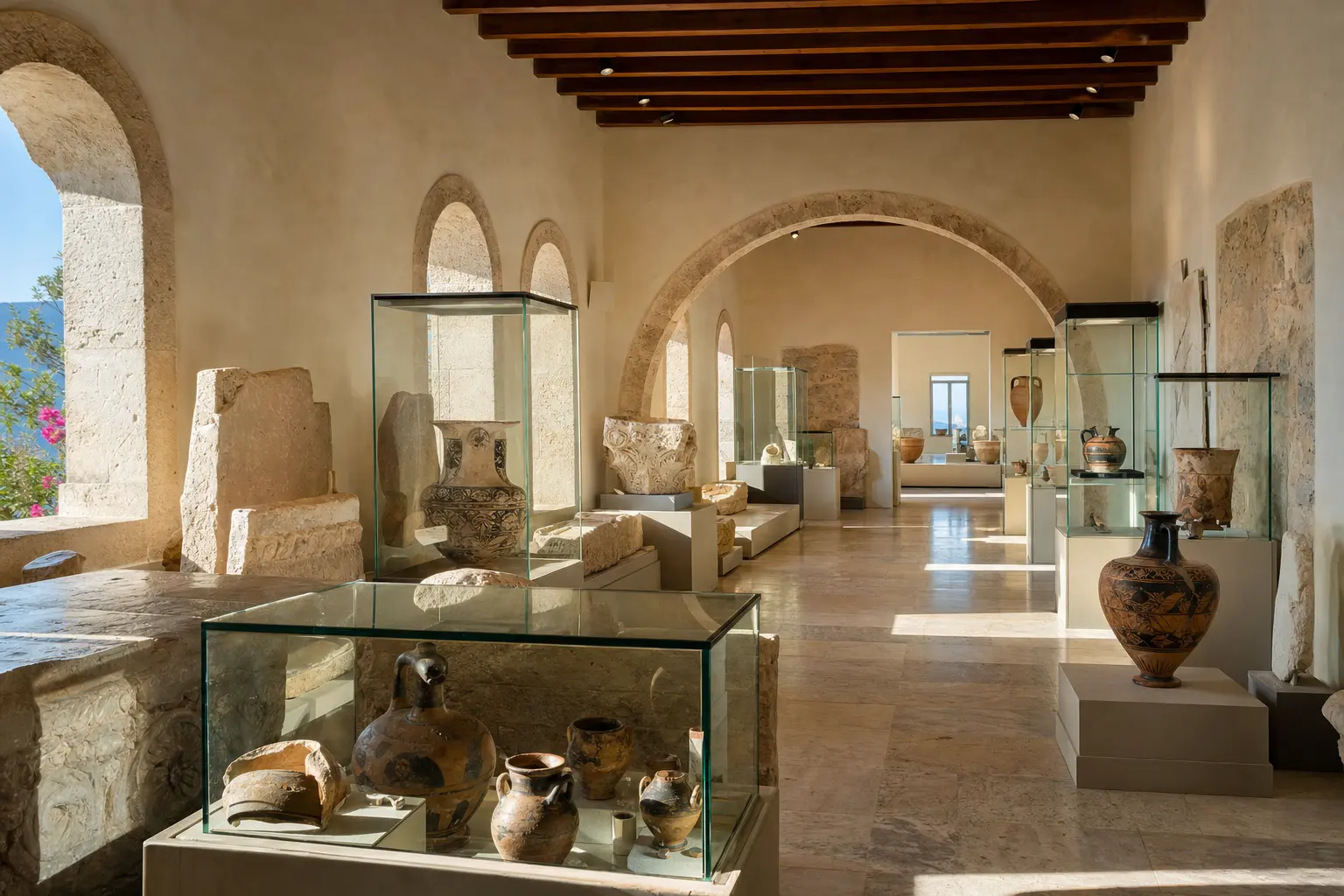
Kastellorizo Archaeological Museum Exhibits: Island History
Kastellorizo Archaeological Museum exhibits reveal the history of a small island settlement through carefully observed details, from antiquity and Byzantine life to seaborne trade and domestic routines. It is not enough simply to see what is inside each display case. The rim of a vessel, wear on a stone surface, a marine motif or the reuse of an architectural fragment can open another layer of Kastellorizo history.
The museum stands above the colourful harbour, within the island's historic settlement. Its collection is not intended to compete in scale with the great museums of Athens or other capitals. That is precisely what makes it valuable. Objects from a limited geographical area bring the connections between the island, the Anatolian coast, Rhodes and the Eastern Mediterranean into sharper focus. When you look back across the harbour afterwards, the boats, houses and hillside buildings no longer seem like scenery alone.
If you are visiting Kastellorizo from Kas on a day trip, it helps to divide your time carefully. The museum, castle area, rock tomb and harbour walk can be combined into one route. For a broader plan, our Kastellorizo island guide and suggested itineraries explains how the principal stops relate to one another.
How do Kastellorizo Archaeological Museum exhibits tell the island's story?
Why the museum matters on such a small island
Kastellorizo, known in Greek as Megisti, is a small island beside the sea routes of the Eastern Mediterranean. Its limited area does not imply a limited history. On the contrary, maritime connections become essential in a settlement where fresh water and agricultural land are scarce. The sheltered harbour, proximity to the Anatolian coast and links towards Rhodes made the island a useful port of call in different periods.
The Archaeological Museum of Megisti presents this long past through modest pieces of material evidence rather than one grand narrative. Pottery fragments suggest habits of consumption, architectural stonework points to public or religious buildings, and inscriptions raise questions about language and identity. Many individual objects may not look spectacular on their own. When pieces found in the same area are considered together, however, they create a stronger picture of production, trade and belief.
Small island museums have another advantage: the distance between an artefact and the landscape from which it came is unusually short. Only minutes after examining a stone fragment in a display case, you may notice similar local material around the castle or in older buildings. For geographical and historical context before your visit, begin with this introduction to Kastellorizo.
The relationship between object, period and geography
Matching an object only to its century can turn a museum visit into a memory exercise. A more useful approach is to ask why that object was present on this island. An amphora fragment may tell you about its port of origin as well as the product it carried. A capital can reveal stoneworking traditions in addition to the building it decorated. A grave object may offer evidence of social status as well as burial customs.
Throughout its history, Kastellorizo has remained physically and visually close to the Anatolian coast. In clear weather, the shoreline around Kas is plainly visible. Similarities in artefacts should therefore be considered not only alongside the Greek islands, but also in relation to Lycia and neighbouring coastal settlements. Similar appearance alone cannot prove migration or trade. Dating, clay analysis, archaeological context and inscriptions are needed to support such conclusions.
Where should you begin a chronological reading of the collection?
Essential information to find on object labels
Rather than heading immediately towards the most decorative object, first look at the arrangement of the exhibition. If the rooms or cases follow a chronological order, try to keep to it. A sequence makes changes in form easier to recognise. Two vessels with the same basic purpose can reveal how manufacturing methods and preferences changed over time.
Look for the following details on labels:
- Date: Is the object assigned a precise year, a range of centuries or a broad historical period?
- Material: Is it made from fired clay, marble, local stone, metal or glass?
- Findspot: Was it recovered from a grave, settlement, shoreline, building or underwater context?
- Function: Was it intended for domestic use, transport, storage, ritual offering, burial or architecture?
- Condition: Is the piece complete, reconstructed or identified by comparison with better preserved examples?
Labels may include Greek and English descriptions. If a technical term is unfamiliar, note the form, material and date instead of guessing. Researching the terminology afterwards is more reliable than making a hurried assumption beside the case.
Why do findspot and function matter?
The same pottery fragment can carry different meanings depending on whether it came from a house floor, grave or shipwreck. A domestic find may relate to daily consumption, a grave deposit to ritual, and an underwater example to transport and trade. When examining the museum's collection, archaeological context deserves as much attention as the object itself.
Use can leave marks on a surface. Blackening beneath a cooking pot may indicate contact with fire, while wear around the rim could suggest frequent handling. A second cut along the edge of an architectural element may point to later reuse. Such clues are not sufficient on their own. If the museum label or catalogue offers a documented interpretation, give that information priority.
Separating established information from interpretation
An object based visit requires disciplined interpretation. The material, date and findspot printed on the label are information supplied by the museum. Imagining that a vessel belonged to a particular fishing family is personal interpretation unless evidence supports it. In your notes, mark documented details as label and your own deductions as interpretation.
A good museum visit is not about pretending to know every object's story. It is about recognising which questions the available evidence can answer.
This distinction helps you read island history without romanticising it. In a place with a strong maritime identity, it is tempting to identify every vessel as a trade amphora and every piece of metal as ship equipment. Unless form, dating and context support that conclusion, caution is the sounder approach.
Maritime connections in Kastellorizo's ancient artefacts
Traces of daily life in pottery
Among Kastellorizo's ancient artefacts, ceramics are one of the most informative groups despite their ordinary appearance. Fired clay was affordable, widely used and easily broken, so archaeological sites often contain large quantities of pottery. Vessel forms varied according to activities such as preparing food, serving, storing and transporting goods.
When studying a ceramic vessel, distinguish between its rim, handles, body and base. A shallow vessel with a wide mouth may have been used for serving, while a narrow neck could suit the storage or transport of liquids. Thick walls may indicate a need for durability. Fine walls can suggest more controlled production. Slip, paint or incised decoration provides further clues about the vessel's setting and aesthetic value.
Colour alone does not establish origin. The composition of the clay matters, but so do firing temperature and the oxygen level within the kiln. Observe orange, red, grey and dark surfaces, but do not assign a production centre on colour alone. If a label names a region of manufacture, that identification should normally be based on scientific analysis or comparison with documented examples.
Evidence of trade and maritime networks
Transport amphorae are among the most recognisable material remains of maritime trade. Pointed bases, elongated bodies and strong handles made many types suitable for stacking aboard ships. Wine, olive oil and other products were transported in such containers at different times. Stamps, incised marks and distinctive handle forms can provide additional evidence about production and circulation.
An imported vessel indicates more than the arrival of a product. Consumption habits, systems of measurement and sometimes dining customs travelled with containers and their contents. Evidence of local production, by contrast, may show that islanders were not merely consumers. If labels identify local and imported pottery, compare their forms, fabrics and surfaces.
Do not search for maritime evidence only in amphorae. Anchor fragments, weights, coins, non-local stone and images of marine life can also point towards wider connections. Yet not every exhibited object must relate directly to seafaring. The Kastellorizo Archaeological Museum exhibits represent domestic life and religious practice as well as a harbour economy.
Form and function in stone objects
Stone fragments are easy to pass quickly, especially when their original shape has been lost. A broken block may appear unremarkable, but chisel marks, moulded profiles, sockets and surviving decoration can help identify it as part of a tomb, doorway, column or religious building.
Consider the type of stone too. Local material would reduce transport costs. Marble or another stone known to have come from elsewhere may offer clues about commercial connections and the resources available to a patron. If only the front surface is carefully finished, the rear may once have been concealed within a wall. A small piece finished on every side may have been designed for freestanding use.
Reading the Late Antique and Byzantine periods through objects
Understanding religious symbols in context
Christian imagery became increasingly visible in public and domestic life during the Late Antique and Byzantine periods. You may encounter crosses, foliage, birds or geometric motifs. The shape of a symbol does not determine its meaning by itself. Interpretation changes according to whether it came from a church, grave, home or another structure.
A stone fragment bearing a cross might have belonged to an architectural feature, gravestone or liturgical furnishing. Plant motifs can carry meaning as well as decoration, but it is unwise to assign one fixed symbolic reading to every leaf. Read the label and prioritise any evidence about where the fragment was positioned in its original building.
What architectural fragments can reveal
Capitals, panels, screens and inscribed blocks can suggest the scale of a lost building. The quality of carving, decorative scheme and choice of stone reflect the resources devoted to its construction. Several related pieces found together may have belonged to a single architectural complex.
Look carefully for evidence of reuse. An ancient block may later have become wall material, a threshold or a structural support. Reuse should not automatically be treated as evidence of poverty. On an island, adapting strong material already at hand is practical. Such pieces physically connect different periods of Kastellorizo's cultural heritage.
Continuity and change between periods
While following the chronology, do not concentrate only on changing symbols. There may be continuity in settlement areas, relationships with the sea, stoneworking methods and storage practices. Political authority and religious belief could change while the basic need for water, food and a secure harbour remained.
One useful method is to compare objects with similar functions. An ancient storage vessel and a later example may differ in capacity, handle form and surface treatment. The language or lettering of a funerary inscription may change. In this way, the history of Megisti appears not as a set of disconnected periods, but as accumulated layers of island life.
How to notice details among the Kastellorizo Archaeological Museum exhibits
Material, colour and manufacturing technique
Ask the same four questions in each display: What is the object made from, how was it shaped, how was its surface finished, and what happened during use? Wheel marks may remain on ceramics, while metal can show signs of hammering or casting. Chisel channels may be visible in stone. Bubbles and variations in thickness can reveal aspects of glass production.
If reflected light obscures a detail, move slightly to one side rather than standing directly in front of the case. Try several angles without touching the case or object. Assess colour with your eyes rather than through a phone screen. Museum lighting can alter tones, so note the lighting conditions if colour is important to your observation.
Breaks, wear and repairs
A broken object is not necessarily an uninformative one. Its fracture can expose wall thickness and internal composition. An old break may differ in colour and wear from damage sustained during excavation. Modern filling between joined fragments may have been used to make the original form easier to understand.
Ancient repairs are particularly revealing. Drilled holes, metal clamp sockets or worked cracks suggest that an object was kept in use rather than discarded. Do not confuse modern conservation with an ancient repair. If the label provides no restoration information, record your observation as a question rather than a conclusion.
Scale and exhibition context
Photographs can give a misleading sense of size. Read the measurements if they are provided, or compare the object cautiously with other exhibits in the same case. A small vessel may have served personal needs, while a large container might indicate bulk storage. Size and function do not always have a simple relationship, however.
Display arrangements are curatorial choices. Objects in one case may come from the same tomb, period or functional group. Visual proximity does not prove an archaeological connection, so read the case heading first. Introductory panels near the entrance to a room often provide broader context than individual labels.
Taking observation notes instead of relying on photographs
Photography is quick, but it can shorten the time spent looking. Try selecting only two or three objects in each room and writing brief notes. A simple line drawing can make you notice a handle joint, decorative direction or change in profile that a quick photograph might miss.
- Write the object's name and approximate scale.
- Record its material and surface colour.
- Note one sign of use or manufacture.
- Copy documented information from the label on a separate line.
- Add one question to investigate after leaving the museum.
Even when personal photography is permitted, rules for flash, tripods and commercial work may differ. Ask staff at the entrance and do not use a device wherever prohibition signs are displayed.
Continue the museum's story through the streets of Kastellorizo
Connecting the harbour with the settlement
As you walk downhill after the museum, pay attention to the slope. Buildings occupy the narrow ground between the shore and hillside. Steps, passages and retaining walls are practical responses to the topography. Maritime trade left traces not only in ships, but also in storage areas, access to the waterfront and the orientation of homes towards the harbour.
The neoclassical houses along today's waterfront are considerably later than the ancient and Byzantine exhibits. Comparisons are still possible in the use of materials, relationship with the sea and density of the settlement. Our guide to Kastellorizo harbour architecture will help you examine the façades and street pattern more deliberately.
Comparing the castle and rock tomb with museum objects
The castle area is a useful place to reconsider the stoneworking seen in the museum. Look for differences in the size and texture of blocks, repairs, and possible signs of reused material. Remember that a fortified structure was rarely completed on one date and then left unchanged. It may reflect repeated interventions.
The Lycian style rock tomb is an especially thought provoking reminder of cultural links with the Anatolian coast. Its façade, direct carving into the rock and chosen position provide a different scale from the museum's portable stonework. Observe the architecture rather than inventing a precise personal story for its occupant. To organise the castle, tomb and other stops, consult this guide to places to visit in Kastellorizo.
Building a short cultural walk
A practical day trip route begins at the harbour, climbs to the museum, continues around the castle and rock tomb, then returns to the waterfront. Slopes and stone steps mean that a short distance on the map can take longer than expected. Wear shoes with reliable grip, carry water in warm weather and account for the midday sun.
Blue Cave boat trips depend on sea conditions. If a trip cannot operate, the museum and historical walk are not merely a last minute substitute. Together they make a rewarding programme in their own right. Use this Blue Cave alternative plan to reorganise your time around the harbour.
Frequently Asked Questions
Where is the Kastellorizo Archaeological Museum?
The museum is above Kastellorizo's main harbour, close to the historic castle area. It can be reached on foot from the waterfront, but the route includes slopes and steps. Follow local signs and confirm current accessibility arrangements in advance if you have limited mobility.
How much time should I allow for the museum?
About 45 to 60 minutes may be sufficient for a general visit. Allow closer to 90 minutes if you intend to read the labels, compare objects and take notes. The appropriate duration depends on your interests and pace.
How can I confirm opening hours and days?
Opening hours can change according to season, public holidays and administrative decisions. Shortly before travelling, consult current announcements from the official Greek cultural authorities. You can also confirm arrangements with museum staff or the visitor information point after arriving. Do not treat opening times in an old blog post as definitive.
Is photography allowed inside the museum?
Photography rules may vary by room, object group or temporary arrangement. Ask at the entrance and expect separate restrictions on flash, tripods and professional equipment. Staff instructions and signs inside the museum take priority.
How can I plan a museum visit with children?
Instead of asking children to read every label, give them a simple task such as finding an animal motif, handle, repair mark or particular colour. Keep the museum section relatively short and plan a harbour break afterwards. Check access conditions beforehand if you need to use a pushchair, as the approach includes steps.
Planning a visit to the Kastellorizo Archaeological Museum
Check current information before travelling
Regardless of whether you travel in November 2026 or at another time, confirm the museum's hours shortly before your visit. Ferry schedules, fares, passport rules and visa arrangements can also change. Check the current official requirements for leaving Turkey and entering Greece before travelling. Our 2026 Greek islands visa and ferry planning guide provides a preparation framework, but current official rules for your nationality and circumstances remain decisive.
If you are coming to Kas from another town or country, allow additional time for reaching the harbour, parking and document checks. Review the practical options in our guide to getting to Kastellorizo via Kas harbour. Do not calculate the day using the sea crossing time alone, since border and boarding procedures also require time.
Add the museum and nearby sites to one plan
Visiting the museum during the first part of the day can reduce the risk of arriving near closing time. You can then continue to the castle and rock tomb before descending to the harbour. During warmer months, tackling the climb in cooler hours is more comfortable. In autumn and winter, remember that daylight fades earlier.
Viewing ancient artefacts before studying the later harbour architecture creates a useful chronological comparison. If time is short, concentrate on the museum, castle and harbour rather than trying to mark off numerous sights. This allows you to understand Kastellorizo's cultural heritage through objects, landscape and the living settlement.
Leave a safe margin before your return ferry
Do not rely on leaving the museum at the last moment and walking straight onto the ferry. Slopes, photographs, crowds and passport procedures can lengthen the return. Be back at the harbour by the time specified by the ferry operator and familiarise yourself with the boarding process. Check the current Kas to Kastellorizo ferry departures close to your travel date.
A route centred on the Kastellorizo Archaeological Museum exhibits turns the island into more than a brief trip across the water. Read the labels, separate evidence from interpretation, and look for the museum's materials and techniques again in the streets. Once your date and travel documents are settled, compare the available sailings and book your Kas to Kastellorizo ferry ticket securely with Meander Feribot.