


 +90 256 612 88 88

Palace of the Grand Master Rhodes: History and Visit Guide
The Palace of the Grand Master Rhodes is one of the first monuments to prioritise when arriving on the island by ferry. It is within walking distance of the harbour, provides a tangible introduction to the government of the Knights Hospitaller, and fits comfortably into a day trip thanks to its central Old Town location. Its fortress-like architecture is memorable, but not every interior visible today has survived unchanged from the Middle Ages. To understand the building properly, visitors need to consider three main chapters together: the rule of the knights, the destructive explosion of 1856, and the extensive reconstruction undertaken during the Italian administration.
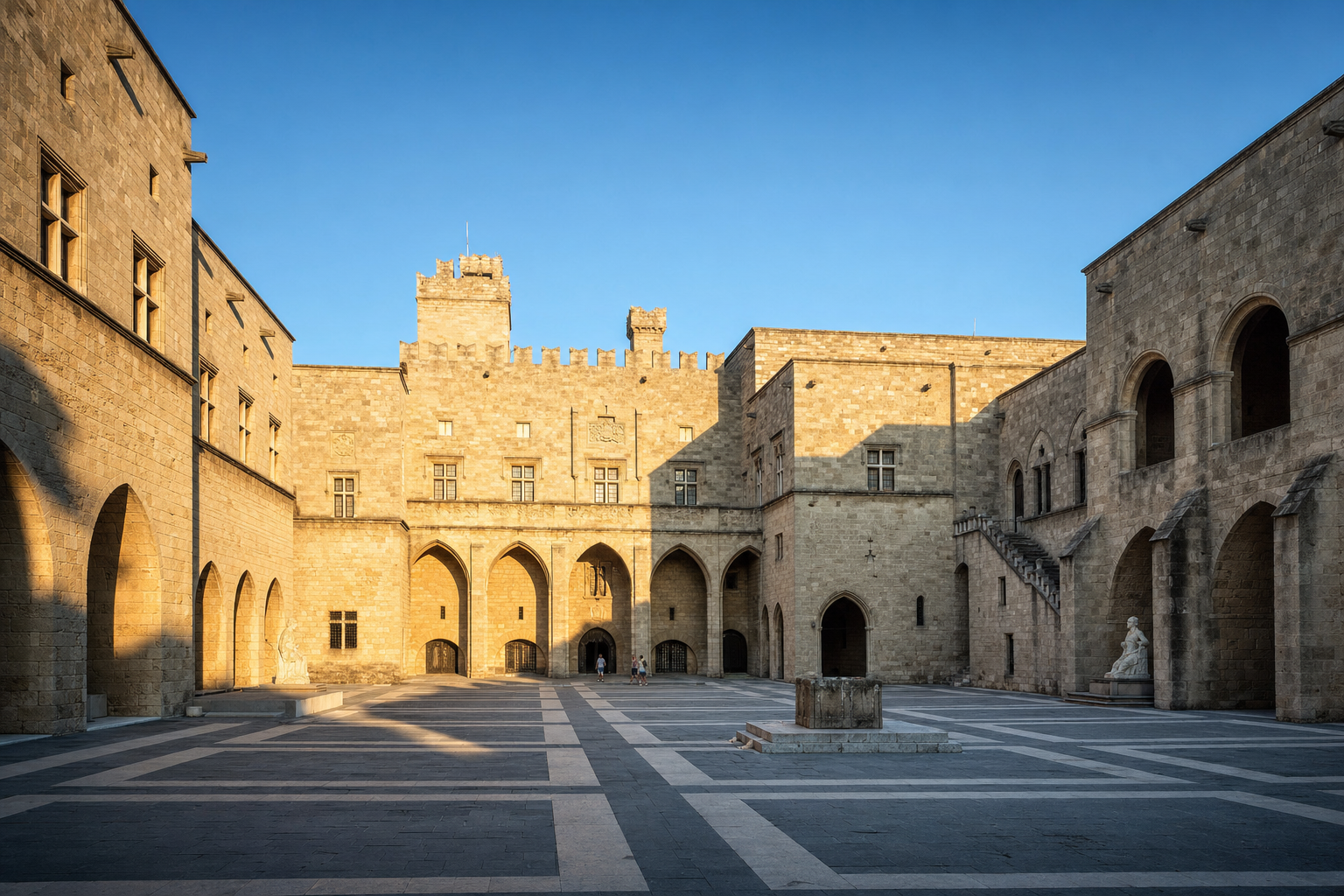
From outside, the palace is immediately recognisable by its twin-towered entrance and thick stone walls. Inside, the broad courtyard, ceremonial halls, statues and mosaics transferred from other archaeological sites attract most attention. The palace can be visited as a museum in its own right, although it makes more historical sense when combined with the Street of the Knights, the Archaeological Museum of Rhodes and the gates of the fortified city. If you are building a wider island itinerary, our Rhodes Island travel guide will help you compare the palace with other places around Rhodes.
Why Is the Palace of the Grand Master Rhodes Important?
The palace matters for more than its size or its dramatic appearance in photographs. The Knights Hospitaller used Rhodes as their headquarters from 1309 until 1522. The Grand Master was the order's political and military leader, and his residence brought several roles together under one roof. It served as a seat of government, a defensive stronghold and a setting for official representation.
As a result, the building resembles a fortified headquarters more than a conventional royal residence. It contains large halls and formal reception areas, but its exterior speaks the language of a powerful castle connected to the surrounding walls rather than that of an elegant country mansion. For travellers hoping to understand the legacy of the knights through a single building, this is the clearest place to begin.
The names Grand Palace and Palace of the Knights
English-language sources may call the monument the Palace of the Grand Master, the Grand Master's Palace, the Knights' Palace or the Palace of the Grand Master of the Knights of Rhodes. These names all refer to the same building. Greek signs use the corresponding Greek name for the Grand Master's Palace.
When asking for directions in Rhodes, saying Grand Master Palace is usually clearer than simply asking for the palace. You will be directed towards the monumental entrance at the upper end of the Street of the Knights. Finding several versions of the name in map applications does not mean that Rhodes has several large palaces belonging to the knights.
Its location within the UNESCO-listed Old Town of Rhodes
The Medieval City of Rhodes was inscribed on the UNESCO World Heritage List in 1988. The palace occupies one of the highest and most strategic points in the north-western part of the walled city. This position was not accidental. A Byzantine fortification is thought to have stood here before the knights arrived, and they appear to have incorporated existing defensive infrastructure into their stronghold.
As you enter the Old Town from Mandraki or the ferry harbour, the stone streets gradually climb. Modern Rhodes begins to disappear from view, replaced by walls, gateways and former inns. To compare the palace's position with other worthwhile stops, consult our guide to places to visit in Rhodes.
The Palace's History, From the Knights to the Present
The history of the Palace of the Grand Master Rhodes is layered because successive administrations altered it to meet their own needs. Its present appearance is not solely the work of 14th and 15th-century masons. Byzantine defences, additions made by the knights, Ottoman-period uses and 20th-century reconstruction all occupy the same site.
The period of the Knights Hospitaller
After the loss of Acre, the Knights Hospitaller of Saint John of Jerusalem sought a new base in the eastern Mediterranean. They settled on Rhodes early in the 14th century. The palace was developed as the Grand Master's residence and the administrative centre of the order. It also functioned as an inner citadel from which defence could continue during an attack.
The knights were divided into linguistic and regional groups from different parts of Europe. The inns lining the Street of the Knights provided accommodation and meeting places for these groups. The fact that the street leads directly to the palace makes the order's administrative structure visible in the layout of the city. Walking uphill from the inns towards the Grand Master's headquarters is almost like tracing its hierarchy step by step.
The city came under severe attack during the Ottoman siege of 1480, but its defenders held out. In 1522, following the siege led by Sultan Suleiman the Magnificent, the knights left Rhodes. The order eventually established itself on Malta, bringing nearly two centuries of rule on Rhodes to an end.
Use of the palace during the Ottoman period
After 1522, the palace lost its former political role. Under Ottoman administration, the complex served military and administrative purposes, while some parts were used as a prison and storage space. The nearby Church of Saint John was also adapted for a different use. Maintenance practices changed, and the interiors did not retain their appearance from the age of the knights.
The Old Town itself remained a living urban district. Mosques, baths and homes were added, while existing buildings were adapted to a new social order. It would therefore be incomplete to see the palace as an isolated monument left solely by European knights. Ottoman buildings in the surrounding streets clearly represent the next three centuries of Rhodes' history.
Explosion, destruction and 20th-century restoration
In 1856, an explosion involving stored gunpowder caused immense damage to the palace. The blast centred on an ammunition store in the area of the former Church of Saint John. Large sections of the palace collapsed, and the complex remained substantially ruined for many years.
During Italy's administration of the Dodecanese, the palace underwent extensive reconstruction. Most of this work was completed in the late 1930s under the Italian architect Vittorio Mesturino. There were plans to use the building as an official residence for Benito Mussolini and King Victor Emmanuel III of Italy. Mussolini, however, never used it as a permanent home.
Many of the monumental interiors seen today are products of this intervention. The reconstruction preserved surviving medieval elements while creating new sections according to a 20th-century vision of a knights' palace. Visitors should therefore distinguish between authentic medieval remains and a later interpretation of medieval history.
Architecture of the Palace of the Grand Master Rhodes
Defensive design and the monumental entrance
The palace's best-known facade is its main entrance, positioned between two cylindrical towers. Narrow defensive openings, thick walls and a controlled access point emphasise the military character of the complex. The facade also expresses the building's relationship with the city walls. This was not an independent mansion, but the administrative heart of a wider fortification system.
Pause outside for a few minutes to study the masonry. The lower levels appear heavier and more enclosed, while the upper sections contain more regularly arranged windows. A queue may form at busy times, so taking exterior photographs after your visit can sometimes be easier than trying to do so before entering.
Courtyards, towers and stonework
Beyond the main passage, the expansive courtyard offers a striking contrast to the tightly packed streets outside. Arcaded sections, stone arches and the monumental staircase leading to the upper floor form the visual centre of the visit. Ancient statues displayed in the courtyard create a deliberate contrast with the palace's medieval character.
Look closely at the walls and you will notice precisely cut blocks beside rougher surfaces. Some coats of arms and architectural fragments evoke the period of the knights, while other details reflect choices made during the Italian reconstruction. Stone floors can be slippery or uneven in places. Shoes with a good grip are more comfortable than thin-soled sandals.
How restoration shaped the present appearance
High ceilings, substantial furniture and large reception rooms create the impression of a complete historic palace. That sense of continuity can be misleading, however. The decorative scheme was not preserved intact across the centuries. Italian administrators transformed the palace into a highly symbolic monument and applied their own aesthetic interpretation of the Middle Ages.
This knowledge does not diminish the visit. On the contrary, it gives the building another layer of interest. The palace reveals both the age of the knights and the way history was reconstructed for political purposes during the 20th century. Details such as the Mussolini inscription dated 1940 make this second historical layer visible.
What Can You See Inside the Palace?
Ceremonial halls and historic rooms
The visitor route on the upper floor includes reception halls, dining rooms and large spaces arranged for formal gatherings. Room names and the sections open to visitors may change with the exhibition layout. Timber ceilings, stone arches, fireplaces and heavy furniture establish the ceremonial tone.
Rather than moving rapidly from room to room, pause at the thresholds and look back. In several halls, aligned doorways produce long sightlines that convey the scale of the palace particularly well once the crowds disperse. If interpretation panels are limited, saving a reliable historical summary to your phone before arriving can make the visit more meaningful.
Mosaic floors and decorative works
Many mosaics inside the palace are not original floors discovered in the Rhodes residence. During the Italian administration, mosaics from Late Antique and Roman buildings on the island of Kos were brought here and incorporated into the decorative scheme. Mythological figures, geometric patterns and images of animals can be seen across the floors of several rooms.
These works should not be viewed simply as decoration. Their relocation from another island also says a great deal about 20th-century attitudes towards archaeology and restoration. Access may be restricted in certain rooms to protect the floors. A normal phone camera is sufficient for recording details without stepping beyond the barriers.
Archaeological collections
Temporary or permanent exhibitions about ancient Rhodes and later periods of the island's history may be presented in parts of the palace. Depending on the current programme, displays can include statues, ceramics, architectural fragments, inscriptions and religious or iconographic objects. Exhibitions change, so do not assume that a particular artefact will always be on view.
For a more systematic archaeological collection, add the Archaeological Museum of Rhodes, housed in the former Hospital of the Knights, to your itinerary. The palace explains authority and representation, while the museum presents finds from different periods of island history. Our general introduction to Rhodes Island provides useful background before you travel.
Best areas for photographs
The most effective compositions usually feature the twin towers, the broad inner courtyard and the monumental staircase. Looking up the Street of the Knights towards the palace also shows how the building fits into the medieval city. The street may be quieter in the morning, while late afternoon can give the stone facade a warmer colour.
Rules concerning flash, tripods and professional equipment can change. Follow the current instructions displayed at the entrance. When photographing floor mosaics, avoid stepping backwards while looking only at your screen. Raised thresholds and changes in floor level are easy to miss.
How Should You Plan Your Palace of the Grand Master Visit?
Checking current opening hours and ticket information
Opening hours can vary according to season, public holidays and museum operations. Admission prices, concessions and free-entry dates may also change. Check current notices from the official Greek cultural authorities before travelling, then look again on the day of your ferry crossing in case of a last-minute alteration.
The ticket office can become busy. If online admission or timed entry is in operation for your 2026 visit, rely only on conditions published through official channels. If a combined ticket is available, confirm which sites it covers and how long it remains valid.
How much time to allow
About 90 minutes is a balanced allowance for most visitors who want to see the palace without rushing. Those reading the historical material closely and spending time in every exhibition may need around two hours. Travellers interested mainly in the courtyard, principal halls and mosaics can complete the route in roughly one hour.
- Quick visit: 45 to 60 minutes for the courtyard and main rooms.
- Balanced visit: 75 to 90 minutes for the halls, mosaics and photography stops.
- Detailed visit: Two hours or more for all open exhibitions and interpretation panels.
These estimates do not include time spent queuing. Day-trip ferry passengers should build at least 20 to 30 minutes of flexibility around the time allocated to the palace.
Choosing a time according to crowds and weather
Midday can be hot in Rhodes during high summer. Although parts of the Old Town offer shade, the uphill walk and stone paving may become tiring. Early morning generally provides more comfortable conditions. The sun can still be strong in September 2026, so carry water, a hat and sun protection.
Rain can make the stone streets and courtyard slippery. On days when large cruise ships are in port, the main streets and ticket office may be especially busy. Going directly to the palace after leaving the ferry, then saving shopping and lunch for the return walk, is often the most practical approach.
Accessibility and visitor rules
As a historic building, the palace contains stairs, thresholds, stone paving and changes in level. Accessibility measures or a lift may be available in some areas, but visitors should not assume that every room is wheelchair accessible. Confirm current arrangements with the museum before your visit.
Rules for large bags, food, drinks and photography, along with the final admission time, may change. Read the instructions at the entrance. The courtyard offers room for children to move comfortably, but stairs and narrow passages on the upper route may require parents to carry a pushchair. A compact folding model is the most practical choice.
Adding the Palace to a Rhodes Old Town Route
Walking from the ferry harbour to the palace
The precise berth used by passenger ferries from Turkey can vary according to operations, but the harbour gates of the Old Town are generally close by. After passport control, most visitors can enter through the walls and reach the palace in approximately 15 to 25 minutes on foot. The actual time depends on the terminal exit, crowds and gate used.
Cobbled and stone streets are inconvenient with a suitcase. On a multi-night stay, leave luggage at your accommodation. For a day trip, carry a small backpack instead. Travellers planning to explore without hiring a vehicle can also read our guide to car-free Greek island travel.
Combining the palace with the Street of the Knights
The most meaningful sequence is to walk uphill along the Street of the Knights before entering the palace. Inn facades, coats of arms and arched passages introduce the institutional world of the order, making the palace the natural finale. To avoid crowds, reverse the route: visit the palace first, then descend the street towards the Archaeological Museum.
- Enter the Old Town from the ferry harbour.
- Walk to the lower end of the Street of the Knights.
- Continue uphill, examining the former inns on the way.
- After the palace, walk towards the Suleymaniye Mosque.
- Return to the harbour through Hippocrates Square.
Nearby historic stops
Nearby landmarks include the Street of the Knights, the Archaeological Museum of Rhodes, the Suleymaniye Mosque, the Clock Tower and access points connected with the city walls. Hippocrates Square and Socrates Street are busier shopping areas. For lunch, walking a few streets away from the main thoroughfare will usually produce a quieter table.
Trying to combine the Old Town palace with a distant destination such as Lindos in a single day can create unnecessary transport pressure. A day focused on the walled city is efficient and largely walkable. Compare other possibilities using our overview of the highlights of Rhodes.
Sample itinerary for day visitors
After passport control, walk directly into the Old Town and make the palace your first major stop. Allow about 90 minutes, then descend through the Street of the Knights. Set aside at least another hour for the Archaeological Museum, or replace it with the Suleymaniye Mosque area and market streets. Finishing lunch at least two and a half hours before your return departure leaves a sensible margin.
A short walk around Mandraki Harbour may fit into the final part of the day. Do not miss the time stated for being back at the port for check-in and border procedures. Ferry programmes can change, so consult the latest Marmaris to Rhodes ferry departures for current outward and return information.
Frequently Asked Questions
Are the Grand Palace of Rhodes and the Palace of the Grand Master the same place?
Yes. The Grand Palace, the Palace of the Knights and the Palace of the Grand Master are names used for the same historic building. On English maps, it commonly appears as the Palace of the Grand Master.
How long does it take to visit the palace?
Between 75 and 90 minutes is sufficient for most visitors. Allow two hours if you want to examine the exhibitions closely. On a tight day-trip itinerary, the principal sections can be seen in about one hour.
Is the palace within walking distance of the ferry harbour?
Yes. It can be reached on foot from most passenger terminals. Depending on the terminal and city gate, the walk usually takes approximately 15 to 25 minutes. This estimate does not include passport control.
Is there an admission fee for the palace?
The palace operates as a museum, so an admission ticket is normally required. Prices, concessions and free-entry days can change. Check the current information published by the responsible authority before your 2026 visit.
Can the palace be visited with a pushchair or wheelchair?
Some areas, including the courtyard, are easier to navigate, but stairs, thresholds and historic stone floors can make the complete route difficult. Ask the museum about current lift access and accessible routes in advance. A folding pushchair is generally more convenient.
Plan Your Rhodes Palace Visit from Marmaris
Building your visit around the ferry schedule
Plan around your return ferry rather than only the palace's closing time. The scheduled arrival in Rhodes is not the same as the time at which you will leave passport control. You must also return to the terminal before the stated departure time. Leave separate margins for port procedures in both directions when calculating usable sightseeing time.
For more detail about the crossing and terminal process, read our guide on how to get to Rhodes. Remember that weather and operational conditions can affect ferry services.
Completing ticket, passport and visa checks
Before travelling, make sure the name and document details on your ferry booking match your passport. Requirements for a valid passport, Schengen visa or any special short-stay island visa arrangement depend on nationality and individual travel circumstances. Check current requirements before travelling and verify the official rules that apply to your passport.
Travellers considering a visa-on-arrival or special island visa process should not leave document submission until the ferry date. Eligibility, participating routes, procedures and deadlines can change. Use our 2026 Greek islands visa-on-arrival guide to understand the planning steps, then confirm your position with the relevant official authorities.
Returning to the harbour before departure
Crowds in the shopping streets can slow the walk from the palace to the harbour. Do not rely on the shortest time shown on a map or leave the return until the last moment. Mark your terminal location when you arrive in the morning and follow the carrier's stated check-in time. Taking care of water, toilets and shopping before entering passport control will make the final stage easier.
Choose your travel date first, then confirm the current outward and return services. Placing the palace in the morning and reserving the afternoon for the Old Town streets is the lowest-risk plan for most day visitors. Once your trip is settled, check Marmaris to Rhodes ferry tickets with Meander Feribot and complete your booking.