


 +90 256 612 88 88

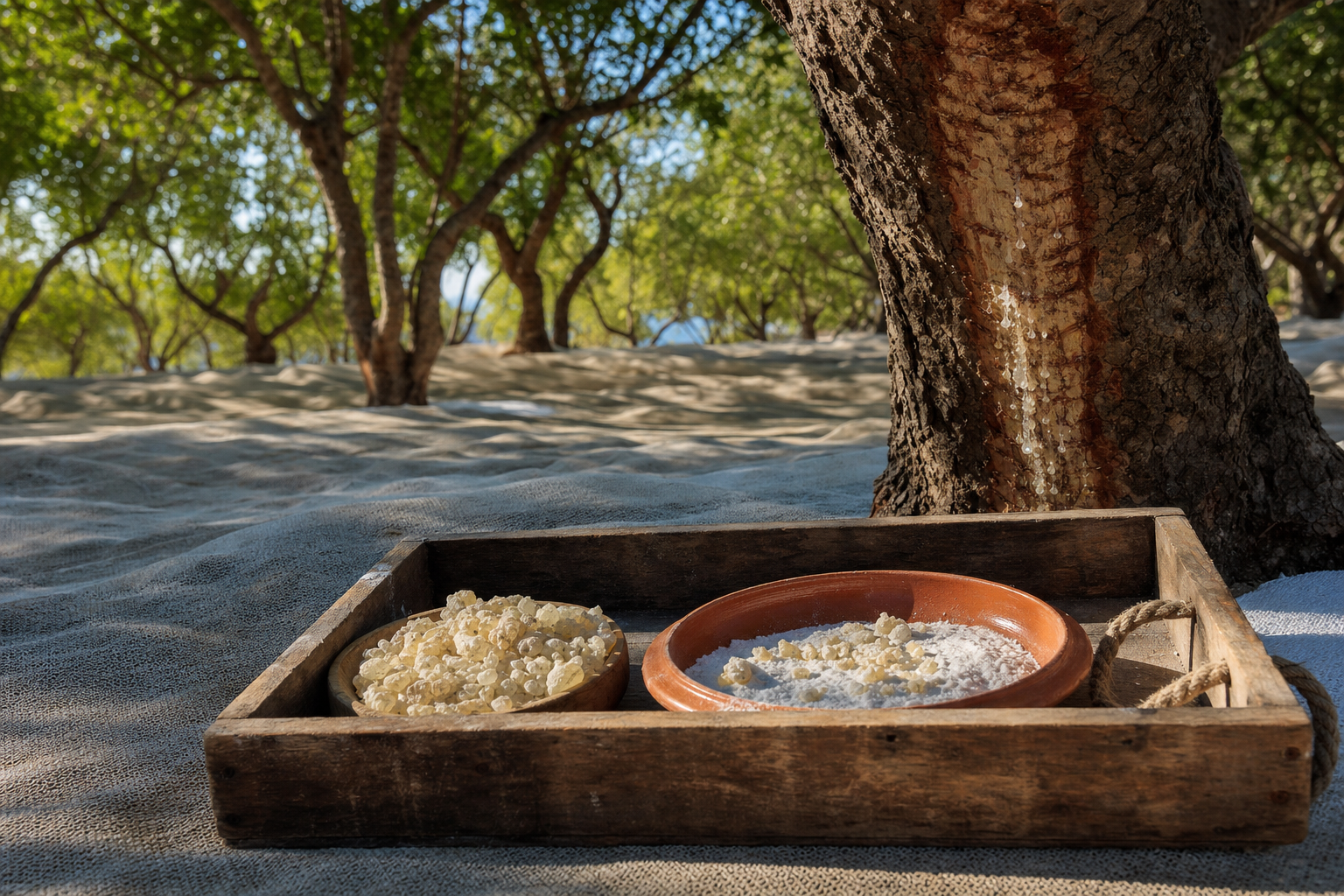
Chios Mastic From Tree to Table: Harvest and Uses
The journey of Chios mastic from tree to table begins with small, controlled incisions in the trunk of an unassuming evergreen in southern Chios. Clear resin seeps from the bark, falls onto specially prepared white ground, dries in the summer air and is gathered by hand. Only after weeks of cleaning and sorting is it ready for the kitchen. Behind the few grams of crystals in a packet lies a careful production cycle extending across much of the year.
To understand authentic mastic, it helps to see more than the finished product. In southern Chios, the white circles beneath the trees, the crystals being cleaned in village homes and the faint pine like fragrance drifting from bakeries all reveal why mastic is costly. They also show how closely the product is tied to its place of origin. For broader background before your visit, start with our introduction to Chios and its distinctive character.
Why Is Mastic So Closely Associated With Chios?
The climate and soil of southern Chios
Mastic is the natural resin of a particular variety of Pistacia lentiscus, commonly called the mastic tree. Although members of the species grow elsewhere around the Mediterranean, the regular production of commercially valuable resin with this characteristic aroma is associated above all with southern Chios. Local soil, dry summers, temperature, wind patterns and generations of selective propagation all play a part.
The southern part of the island is hot and dry in summer. These conditions allow resin to harden slowly without being spoiled by rain. The pale, stony and often calcareous terrain may look difficult for agriculture, but mastic trees tolerate drought and relatively poor soil. Once established, mature trees form compact, densely branched shapes across the dry landscape.
Climate alone does not explain the difference. Yield and quality also depend on how growers shape the tree, prepare the ground, space the incisions and collect the resin without contaminating it. A similar tree might grow elsewhere, but the accumulated knowledge of southern Chios cannot simply be transplanted with a sapling.
The mastic villages known as Mastichochoria
The villages of southern Chios are collectively known as the Mastichochoria, meaning the mastic villages. Pyrgi, Mesta, Olympi, Kalamoti and Armolia are among the best known stops in this cultural region. Their tightly packed streets and defensive layouts are also connected with the historic need to protect valuable mastic production during the Middle Ages.
In Pyrgi, black and white geometric patterns scored into the façades immediately catch the eye. Our guide to the xysta motifs of Pyrgi explains how to read these distinctive designs. Mesta and Olympi have a different atmosphere, shaped by narrow passages, stone arches and houses built closely against one another. The mastic groves are generally outside the settlements, so sitting in a village square will not necessarily bring you into contact with the production areas.
The place of mastic production in island culture
Chios mastic production is not a one day harvest. Different members of a family may take part, from preparing the soil to cleaning the crystals during the colder months. Traditionally, cleaning was a shared household task as well as a way of passing knowledge between generations. Recognising a sound crystal and removing tiny pieces of bark or soil are skills acquired through repeated work.
The traditional know how behind mastic cultivation on Chios was added to UNESCO's Representative List of the Intangible Cultural Heritage of Humanity in 2014. What is protected is not simply the finished resin, but the local methods of caring for the trees and the community memory around them. A visit to the mastic villages therefore makes most sense when the fields, architecture, cooperative system and food culture are considered together.
The Annual Mastic Tree Cultivation and Production Cycle
Pruning and caring for the trees
During the tree's winter resting period, growers lay the foundations for the next harvest. Dry, damaged or rubbing branches are removed. The aim is a balanced form that allows air and light into the centre while leaving the trunk accessible. Severe pruning can stress the tree, while neglecting it can make both scoring and harvesting more difficult.
A newly planted tree does not produce a commercial crop immediately. Its roots, trunk and main branches need years to develop. Even among mature trees, the quantity of resin varies according to age, health, cultivation and seasonal conditions. It would be misleading to assume that every tree produces the same number or size of mastic tears.
Preparing the ground before the Chios mastic harvest
At the beginning of summer, growers clear weeds, stones and old plant material from beneath each tree. The soil is levelled, then covered with a fine calcareous material locally described as white earth. This pale layer is not decorative. It creates a cleaner collection surface and helps prevent falling resin from sticking to dark soil.
From a distance, the prepared circle can resemble a light coloured cloth spread beneath the branches. Every hollow, stone or fallen twig can contaminate the resin, so levelling requires care. A properly prepared surface reduces the time needed for later cleaning and helps preserve the appearance of the crystals.
Seasonal conditions that affect production
The Chios mastic harvest normally takes place during the dry summer period and may continue into early autumn. Exact starting and finishing dates vary according to weather, local decisions and the organisation of the work. Travellers visiting production areas in autumn 2026 should ask locally or at the museum whether active fieldwork is still taking place.
- Long periods of dry weather help the resin harden cleanly.
- Unexpected rain may spread resin that has not yet set or contaminate it with soil.
- Extreme heat and strong winds can affect working hours.
- The health of each tree influences the number and frequency of incisions.
Experienced producers do not follow the calendar blindly. They assess the trunk, the flow and condition of the resin, and the weather forecast together. This is one of the points at which agricultural judgement matters most.
How Are the First Mastic Tears Drawn From the Tree?
Controlled scoring of the trunk and branches
Once the ground has been prepared, growers make small cuts in the trunk and in suitable main branches. This process is often called kentima. A pointed tool scores the bark in a controlled way. The purpose is not to wound the tree deeply, but to create shallow openings that stimulate its resin channels.
The cuts are not all made randomly or in a single session. A grower returns at intervals, responding to the tree's size and condition. Too many cuts, or cuts made too deeply, can harm it. Too few limit the potential crop. This is the most delicate part of explaining how Chios mastic is produced: collecting resin must always be balanced against protecting the tree's health for future seasons.
How the drops form and dry
Fresh resin is clear and sticky. It may swell into a tear on the trunk, run down in a thin line or fall directly onto the prepared ground. Contact with the air gradually hardens the outer surface. The initial transparency can change into a cloudy pale yellow or ivory colour as the resin sets.
Large drops may take longer to solidify than small ones. If resin is collected too early, it can be crushed and contaminated. Scoring, waiting and gathering are therefore separate stages requiring patience. The irregular shapes found in a packet are the natural result of flowing, hardening and occasional breakage.
The value of a mastic crystal comes from more than its aroma. Its price also reflects the time spent forming on the trunk, falling, drying and being cleaned individually.
The effects of rain and wind during harvest
Rain presents a serious risk to resin that has not dried. It can spread the drops across the white surface and bring them into contact with mud or other matter. Strong wind may carry leaves, twigs and dust beneath the trees. Harvest days are consequently chosen according to short term weather conditions as well as the availability of labour.
Visitors should keep their expectations realistic. You may not see scoring on the day you reach a grove. Do not enter working land without permission, step on the prepared white circles or pull resin from a tree. These are active agricultural sites, not staged visitor attractions.
How Are Mastic Tears Cleaned and Graded?
Gathering the hardened resin
Once sufficiently firm, the largest pieces can be picked up by hand. Smaller fragments are carefully gathered with some of the white ground material and taken away for sieving. Drops that remain attached to the trunk are removed separately. The sequence and tools are intended to prevent unnecessary breakage, loss and contamination.
What enters the harvest container is not yet clean enough for culinary use. It may contain small stones, leaves, bark, soil and pieces of resin stuck together. One of the most labour intensive parts of the journey to the shop shelf now begins.
Traditional sieving and mastic tears cleaning
First, sieves separate pieces of different sizes and remove some foreign material. The resin is washed using suitable methods and allowed to dry again. Each crystal is then inspected individually. Dark marks, bark and dirt adhering to the surface may be removed with a small knife or pointed tool.
Rushing the cleaning process reduces quality. Excessive scraping makes crystals unnecessarily small, while inadequate cleaning affects their purity and appearance. During traditional household sorting, keeping hands cool can also help because warmth softens the resin and makes it sticky.
Sorting by size, appearance and intended use
Cleaned mastic is graded according to size, wholeness, colour and purity. Large tear shaped crystals tend to be the most visually attractive. Small or broken pieces are not worthless. They may be ground for cooking or allocated to industrial processing. The same aromatic resin reaches the market in several forms and quality categories.
- Large crystals: Often selected for sale whole or for chewing.
- Small crystals: Practical for grinding and adding to recipes at home.
- Powder: Easy to measure, although ingredients and signs of clumping should be checked.
- Processing grade resin: Used for oils, extracts, drinks or cosmetic products.
How Is Mastic Processed and How Can You Identify the Real Product?
Crystals, powder, oil and flavoured products
The simplest form is cleaned natural resin sold as crystals. These can be chewed or ground for a recipe. Mastic powder is convenient, but some products contain sugar or another carrier to make grinding and handling easier. Always read the ingredients rather than assuming the packet contains pure mastic.
Mastic oil produced through distillation or extraction is highly concentrated and should not be measured in the same way as crystals. The proportion of real mastic also varies in liqueurs, Turkish delight, sweets, preserves, coffee blends and flavoured desserts. A picture of a mastic branch on the packaging does not prove that the product contains a high percentage of natural resin.
Checking packaging and origin information
When buying authentic Chios mastic, check the product name, ingredients, place of origin, producer or packer, batch number and use by or best before date. Sealed, traceable products that state their Chios origin clearly are a more dependable choice. On products covered by European Union protected designation rules, look for the relevant emblem and registered name.
Natural crystals are not perfectly uniform. Their dimensions and shapes vary, while their colour can range from transparent yellow to cloudy ivory. When chewed, mastic typically breaks into hard fragments at first, then softens with the warmth of the mouth and becomes gum like. Appearance and a chewing test alone, however, cannot prove its origin.
Tips for buying and storing mastic
- Read the ingredients to establish the amount of natural mastic and any additives.
- Avoid unpackaged products of uncertain origin, particularly if they have been left in heat.
- Buy crystals in modest quantities because their powerful aroma means they are used slowly at home.
- Keep the packet away from sunlight, moisture, cookers and oven heat.
- Check powdered products for clumping, unusual smells and damaged packaging before use.
There is no shortage of choice in Chios Town. Shops around the harbour are convenient, but it is worth comparing their products with reputable packaged goods sold in the villages. To build a day around more than shopping, review the main places to visit in Chios before you arrive.
Culinary Uses of Chios Mastic
Desserts, ice cream and baking
Mastic is most familiar in milk puddings, ice cream, biscuits and sweet breads. Its aroma tends to become rounder in mixtures containing milk, cream or another source of fat. For a pudding or rice pudding, pounding a few small crystals with some of the recipe's sugar helps stop the resin sticking to the mortar and distributes it more evenly.
Use a restrained hand. Too much mastic can make a dessert taste bitter, medicinal and overpowering rather than fresh. Begin with the lower quantity recommended in a recipe. In baking, mix finely ground mastic into the dry ingredients so that it does not become concentrated in one part of the dough.
Coffee, liqueur and other drinks
Mastic flavoured Greek coffee is a common island souvenir. Resin added to coffee needs to be very finely ground, as dropping a large crystal directly into the pot will not produce an even result. When buying a packaged blend, check the balance of coffee and flavouring and whether sugar has already been added.
Mastic liqueur is usually served in a small glass after a meal. Chilling it can make the resinous fragrance seem more measured. In alcohol free drinks, mastic syrup may be combined with milk, lemon syrup or plain soda. Syrup often contains a substantial amount of sugar, so it should not be treated as equivalent to natural crystals.
Measured use in savoury recipes
Mastic does not belong exclusively to desserts. In a very small quantity, it can contribute a resinous background to cheese pastries, creamy sauces or some contemporary olive oil based dishes. Its character can disappear, or become muddled, if the same recipe contains powerful amounts of garlic, smoke or very hot chilli.
Choose a neutral base for your first savoury experiment. Fresh cheese, yoghurt or a mild bread dough offers a sensible starting point. Add only a pinch, then assess the flavour after cooking. This protects both an expensive ingredient and the dish itself from waste.
Practical ways to balance the aroma
- Chill the crystals for 10 to 15 minutes before grinding to reduce sticking.
- Pound them with a little sugar or some of the flour from the recipe.
- Add small amounts gradually instead of tipping in a large quantity.
- Use restraint when combining mastic with rose water, vanilla or orange blossom.
- Allow cooked food to rest, as the aroma may seem different once it has cooled.
When tasting food in island bakeries and confectioners, ask about the ingredients or read the label. Not every item described as mastic flavoured is made with natural crystals. Our Chios Island travel guide can help you balance food stops with villages, beaches and realistic driving times.
Frequently Asked Questions
Which tree produces mastic?
Mastic is a natural resin obtained from the variety of Pistacia lentiscus associated with Chios. The resin emerges when controlled, shallow incisions are made in the trunk and suitable branches.
Does the mastic tree produce commercial mastic everywhere?
Relatives of the mastic tree grow around the Mediterranean, but commercial Chios mastic is linked to the environmental conditions, plant material and local knowledge of southern Chios. Planting the same species elsewhere does not guarantee resin with the same quantity or characteristics.
In which months is Chios mastic harvested?
Ground preparation begins in early summer. Scoring and gathering are generally concentrated in the dry period from July into early autumn. Dates vary with weather and production decisions, so anyone hoping to see active work should seek current local information before visiting.
How can you identify authentic Chios mastic?
Origin details, sealed packaging, a clear ingredients list, traceable producer information and the protected designation marking are useful indicators. Irregular crystals are normal, but appearance alone is not proof. Treat unusually cheap, unpackaged products from an unclear source with caution.
How should mastic be stored at home?
Keep crystals in a tightly closed packet in a cool, dry place away from sunlight. Heat may soften the resin and cause the pieces to stick together. Humidity can make powdered mastic clump.
Planning a Ferry Visit to the Mastic Villages and Museum
Travelling from Cesme to Chios
The sea crossing from Cesme to Chios takes approximately 20 to 30 minutes. Allow additional time for passport controls, boarding and possible queues at the port. Operators, schedules and fare options can be compared through the current ferry options to Chios.
Passport, visa and border rules depend on your nationality and the regulations in force at the time of travel. Do not assume that entry will be granted automatically. Check current official requirements before travelling. Our guide explaining how to get to Chios also covers practical port and document preparation.
Allowing time for the Chios Mastic Museum and villages
Chios Town harbour is on the island's east coast, while the main mastic villages are farther south. Pyrgi, Mesta, Olympi and the Chios Mastic Museum are not within walking distance of the ferry terminal. Plan to use a hire car, taxi or an appropriate current public transport service.
The Chios Mastic Museum is a useful first stop for understanding the full production cycle, from cultivation to commerce. Allow at least an hour and a half for its displays, then continue to Pyrgi or Mesta for an unhurried walk. Trying to fit four villages, the museum, a beach and a long lunch into one day usually produces a rushed and superficial visit.
A balanced day trip could follow this order:
- Take a morning ferry to Chios Town and continue south using transport arranged in advance.
- Begin at the Chios Mastic Museum to understand the stages of production.
- Walk around Pyrgi's square, narrow streets and decorated façades.
- If time permits, choose either Mesta or Olympi rather than rushing through both.
- Leave a generous margin for returning the vehicle and completing port procedures before your ferry.
Museum opening days and hours can change, so confirm the latest information before setting out. To decide which other stops deserve priority, consult our overview of the highlights of Chios.
Choosing a visit according to the production season
Late summer and early autumn can be rewarding times to see the prepared white surfaces beneath the trees and signs of the harvest cycle, provided the weather has been suitable. Agricultural work is not a performance, however. Watch from a respectful distance, ask before taking close photographs and never step onto the white ground beneath a tree.
By mid October, and specifically as of 13 October 2026, the main scoring and gathering work may already have finished in some groves. Visitors can still learn about cleaning, grading and processing at the museum and appropriate village sales points. Spring does not bring an active harvest, but it offers quieter conditions for observing tree care and the landscape of southern Chios.
Once you have chosen your travel date, check the ferry departures first, then arrange your vehicle and museum visit around them. Reduce the number of villages if the return sailing leaves limited time. You can compare availability and complete your booking with Meander Feribot through the Cesme to Chios ferry ticket page.