


 +90 256 612 88 88

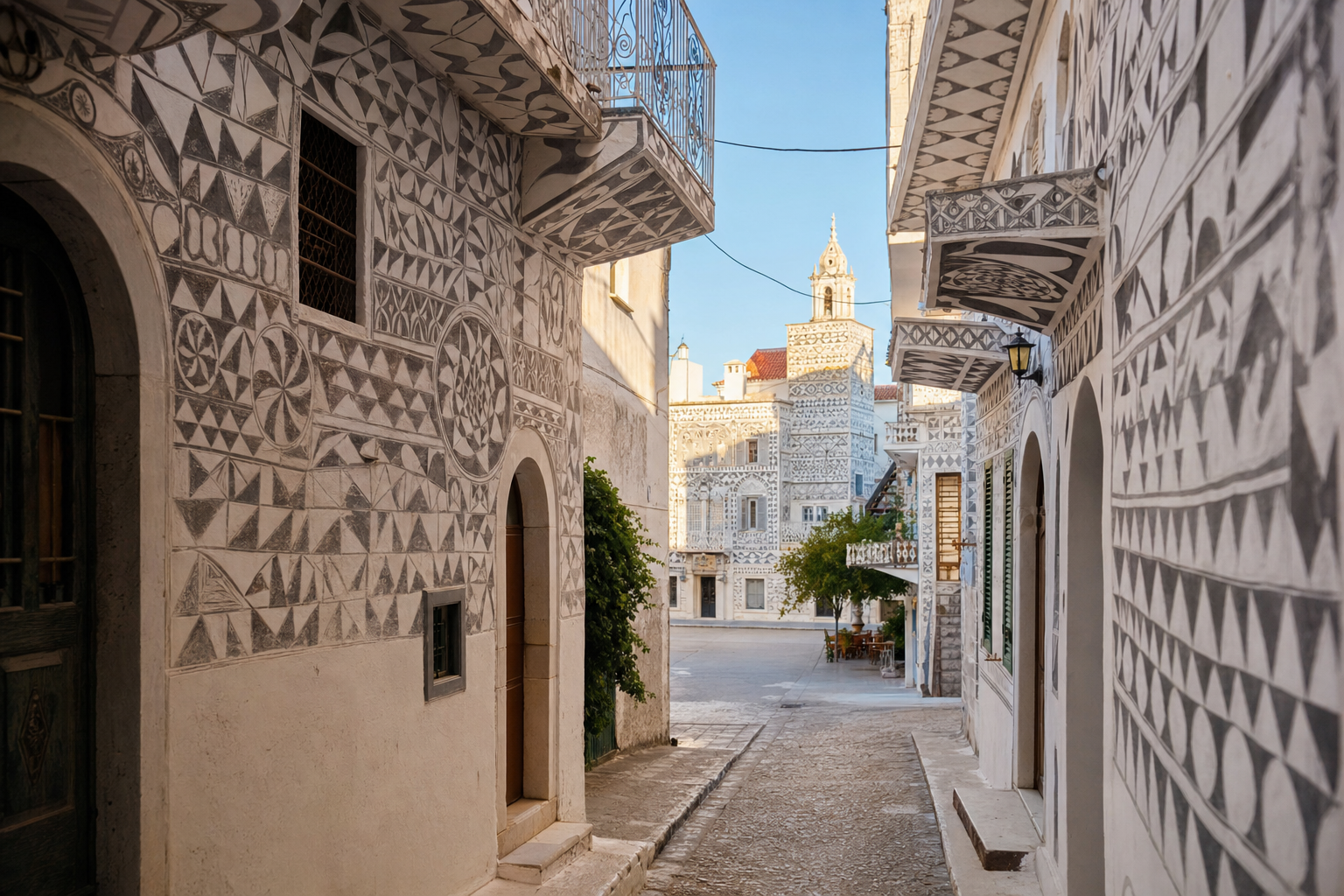
Pyrgi Xysta Motifs: A Guide to Reading the Facades
Pyrgi xysta motifs are the black, white and grey facade patterns that make this southern Chios village instantly recognisable. Yet treating them merely as decoration means missing how they were made and how closely they respond to the architecture beneath them. Begin your observation from a distance, identify the bands dividing each storey, then move closer to study the window surrounds and the small marks left in the scratched plaster.
Pyrgi village rewards more than a quick stop for photographs. Even along one street, neighbouring facades may differ in rhythm, border width and their response to light. At the same time, it is unwise to assign a secret meaning to every shape. Unless a documented explanation exists, the most reliable approach is to describe what you see through geometry, repetition, surface treatment and architectural position.
For travellers arriving by sea from Cesme, Pyrgi is reached by road from Chios Port and lies in the south of the island. If this is your first visit, use our Chios Island travel guide to understand the island's geography and plan a realistic amount of time for the village.
What Makes Pyrgi's Decorated Houses Special?
Pyrgi's place among the mastic villages
Pyrgi is one of the Mastic Villages of southern Chios. These settlements belong to a rural and economic landscape shaped over centuries by the cultivation of mastic. The village's compact plan, narrow lanes and concentration of buildings around its centre cannot be explained by appearance alone. Sun, wind, defence, relations between neighbours and limited building space all helped create this dense urban fabric.
The most visible feature distinguishing Pyrgi from nearby villages is the scratched decoration covering many of its facades. Even so, the village should not be treated as an open-air pattern exhibition. These houses remain lived-in spaces. Ground-floor doors, narrow passages, daily activity in the square and balconies above the street remind visitors that the decoration belongs to a functioning community. To connect Pyrgi with other southern stops, compare possible routes in our guide to places to visit on Chios.
What do the names ksista and xysta mean?
What is xysta? In its simplest form, it is facade decoration created by scratching through plaster layers of contrasting colours in a controlled manner. Sources in different languages may use ksista, xysta or related spellings. In the context of Pyrgi, these names generally refer to the same scratched-plaster tradition. A spelling difference does not necessarily indicate a separate architectural technique.
The xysta technique is not a decorative panel attached to a finished wall. Its patterns emerge from the layers of the facade plaster itself. Their importance therefore lies not only in the shapes but also in the way the material was applied and removed. At close range, the incised lines may reveal slight handmade variations that distinguish them from mechanically printed decoration.
How decoration relates to the village fabric
A xysta composition should not be read as though it were a flat pattern on paper. Corners, window openings, balcony undersides, rooflines and storey divisions direct its design. A border may run around a window, a broad geometric field may occupy the space between two floors, or a pattern may turn at a corner and continue along a side wall.
The open space around the village square makes complete facade arrangements easier to understand. In narrow side lanes, your eye is brought much closer to the surface. The texture and depth of the scratched plaster become clearer, but the whole composition may be impossible to see at once. Pyrgi's decorated houses make most sense when examined at both scales.
How Is the Xysta Technique Applied?
Plaster layers and tonal contrast
The technique depends on contrast between plaster layers. Where a pale upper layer sits above a darker layer, scratched sections reveal the darker material. On some facades, ageing, dirt, sunlight and repairs mean that the contrast is not simply black against white. Grey, off-white and earthy shades also affect the appearance.
Do not judge this contrast only in midday light. Strong sunshine deepens the shadows cast by tiny ridges and incisions. Cloudy conditions reduce those shadows but may make subtle tonal transitions easier to recognise. Excessive contrast added to a photograph can create hard edges that do not exist on the real plaster, concealing rather than clarifying its material character.
Creating a pattern by scratching the plaster
While the upper plaster remains workable, it is scratched along planned lines to expose the darker layer beneath. The result is not a flat graphic drawn in paint. The edges and depth of each incised area, together with the slight shadows they cast, form part of the composition. Looking across a facade from an oblique angle can reveal more about this process than viewing it straight on.
To reconstruct the likely sequence of work in your mind, look for the following clues:
- The main bands dividing the facade into horizontal sections.
- The basic geometric unit repeated within those bands.
- Narrower borders adapted to windows and doors.
- Repeats interrupted by corners, balconies or changes in width.
- Small differences in measurement or line quality that reveal handwork.
Distinguishing repairs from an original surface
It is difficult to establish the date of a surface through visual inspection alone. Do not assume that a cleaner section must be new or that every worn area must be old. A facade may have been cleaned, replastered or partly renewed at several different times. Without material analysis or documented restoration records, assigning a firm date can be misleading.
You can still make cautious comparisons. If one part has exceptionally regular lines and an even surface tone while an adjoining area has worn edges, this may indicate an intervention. A pattern interrupted around a replacement window may also suggest later work. The responsible wording is this section may belong to a different phase of work, rather than presenting an uncertain conclusion as fact.
The Visual Grammar of Pyrgi Xysta Motifs
Bands, zigzags and diamond patterns
Pyrgi xysta motifs often use a limited set of geometric elements to cover large areas. Horizontal bands separate storeys. Zigzags lead the eye along the facade. Diamonds, formed by intersecting diagonal lines, create a net-like effect across the wall. Changes in line thickness or spacing can give the same basic shape an entirely different rhythm.
When examining a row of diamonds, do not count only the individual shapes. Look at the space between them. Does the dark scratched line dominate, or does the pale untouched plaster command more attention? At the edge, does the pattern end with a complete unit or a cropped half shape? These details show how a craftsperson adapted a repeated scheme to the actual dimensions of the building.
Circles, rosettes and radial compositions
Circular arrangements introduce focal points among linear bands. Rosette-like forms may contain segments or rays extending outwards from a centre. It can be tempting to call these suns, stars or specific religious symbols, but such interpretations should not be made without evidence. A visual description is safer and more useful: centred, radial, divided into multiple segments or formed from concentric rings.
The circle's position on the facade can be as informative as its shape. A single rosette above a window may provide a resting point for the eye in a broad field. A sequence of small circles may instead function as a border. The same form can perform a different compositional role according to where it is placed.
Repetition, symmetry and negative space
Repetition is one of the principal organising devices on Pyrgi's facades, but it is not always exact. The dimensions of a wall, the position of openings and the turn of a corner may cause a motif to contract or expand. Such variations are not necessarily mistakes. They are evidence of geometric design being fitted to a real building.
When looking for symmetry, first identify the architectural axis of the facade. If the main door or window is off-centre, the decorative field may be internally symmetrical while the complete elevation remains asymmetrical. Negative space is the pale plaster left unscratched. Sometimes the apparent shape lies not in the dark line but in the light area enclosed by it. Focus first on the pale areas and then on the dark ones, and you may read two different patterns.
Plant-like and figurative details
Although geometry dominates, you may encounter curving branches, leaves or details that appear figurative. Maintain a distinction between resemblance and identification. A form may look like a leaf, but visual similarity alone is not enough to claim that it depicts a particular plant species.
If you notice a figurative detail, record the geometric frame around it as well. A tightly cropped photograph removes the element from its architectural role. Photograph the full decorative field first, then its border and finally the small detail. This sequence creates a far more useful visual record.
How to Read a Xysta Facade Step by Step
Moving from the whole facade to the details
Begin from the furthest point the street allows. Establish how many storeys the building has, how its roof or upper edge appears and which surfaces carry decoration. Move to a middle distance to separate the main pattern fields. Only then approach the wall to inspect scratched lines, plaster cracks and small signs of repair.
- Find the outer edge of the facade and the line where it meets neighbouring buildings.
- Identify horizontal storey bands and vertical divisions.
- Select the basic motif repeated most frequently.
- Compare adaptations around windows and doors.
- Study corners and points where the pattern is interrupted.
- At close range, observe the plaster layers and scratching marks without touching them.
The relationship between storeys, windows and borders
A window is not simply an accidental gap in the pattern. In many compositions, its surround is emphasised by a separate border or the general repeat is recalculated to fit the opening. You may find denser decoration upstairs and a simpler arrangement at ground level, but do not treat that as a rule applying to every building. Compare several facades before drawing conclusions.
The points where borders meet are particularly instructive. When a horizontal band reaches a vertical window frame, does it stop, appear to continue behind it, or connect through a new corner unit? Such details may suggest whether the composition was designed as a collection of separate sections or conceived as an integrated whole.
Comparing repeated motifs
If you find two similar zigzag sequences in the same street, compare more than their outlines. Note the width of each unit, line thickness, border treatment and amount of pale background. Similarity does not prove that the same person made them. It demonstrates different uses of a shared visual repertoire.
A small notebook can be helpful. Instead of attempting to record private house details, use understandable location notes such as village square, beside the church or narrow passage. Do not label residents or record personal information. Architectural observation requires only the surface's general location and visual characteristics.
Avoiding unsupported symbolic interpretations
Popular accounts often attribute meanings such as prosperity, protection, eternity or family identity to geometric motifs. Unless there is a written record, reliable research or well-sourced local testimony for a particular facade, these explanations cannot be treated as established fact. The most honest approach is to state what you can see and explain how the pattern is arranged.
Reading a motif accurately does not mean naming it immediately. It means describing its form, repetition, material and position on the facade with care.
If you hear a local explanation, consider who provided it and how it was passed down. Oral accounts are valuable, but different families or guides may interpret the same shape differently. Language that acknowledges possibility is more respectful both to the village's culture and to responsible research.
A Pyrgi Walking Guide for Studying the Motifs
An observation route beginning in the village square
The village square is a practical starting point. Its open space gives you a wider view of the facades and helps your eye become accustomed to the main pattern types. Make one complete circuit of the square. On your first round, consider leaving the camera in your bag and concentrating on storey bands, window borders and large geometric fields.
For a second circuit, choose two or three streets leading away from the square. Retracing your route is worthwhile because the light changes when you walk in the opposite direction and previously concealed side walls come into view. To place Pyrgi within a wider island itinerary, compare it with other highlights of Chios according to distance and the time each stop deserves.
Main streets compared with narrow passages
Main streets may offer more room to step back, making large compositions easier to read. In side passages, the distance between you and the wall becomes much shorter. The edges of scratched lines, the grain of the plaster and interventions from different periods may become clearer here.
A wide-angle phone camera can make a building in a narrow lane appear more distorted than it is. If you are creating a visual record, photograph the upper, middle and lower sections separately instead of relying on one extreme wide-angle image. Take a complete view later if you find enough space directly opposite the facade.
Choosing viewing times according to the light
There is no single ideal hour because street orientation and shadows from neighbouring buildings vary. The same facade can look quite different in the morning and afternoon. Slanting light reveals the depth of incisions, while direct light may strengthen tonal contrast. Surfaces in shade can produce more evenly exposed photographs.
If your schedule permits, view the square when you arrive and revisit it before leaving. Even passing cloud can alter the appearance of the plaster. For a mid-September visit, remember that useful daylight fades earlier than at the height of summer. Do not begin a long photography session without allowing time for your return journey.
Details to prioritise during a short visit
If you have only an hour, do not try to complete every street. Choose one whole facade near the square, one window border, one corner turn and one plaster surface visible at close range. This gives you examples at four different scales. Finish with a short loop through the side lanes to understand the compact village plan.
Two hours or more will allow you to compare related motifs and wait for changes in the light. If you also plan to visit beaches, monasteries or other villages, consult the regional overview in our introduction to Chios Island before trying to fit too much into one day.
Photography and Village Etiquette
Framing the texture of the facades
Use a three-frame method for each facade: a wide view showing the building in its street, a middle view showing the pattern arrangement and a close view recording the scratched texture. If scale is unclear in the close-up, include an architectural feature such as the edge of a window. Never place a ruler, coin or other object against the wall.
Try to keep vertical lines straight. Tilting a phone upwards causes them to converge. If there is no room to step back, recording the building in sections is more truthful than forcing the whole structure into a distorted frame. Avoid heavy filters because they alter the genuine tones and signs of wear on the xysta surface.
Respecting privacy and private property
Pyrgi's houses are not stage sets. They are private places where people live. Looking through an open doorway, entering a courtyard or photographing people at windows without permission is inappropriate. There is a clear difference between recording a facade and documenting a resident's daily life. Ask permission if an identifiable person will be the main subject.
A tripod can obstruct movement in a narrow street. Do not remain outside a doorway for long, and keep routes open for pedestrians and motorbikes. Quiet behaviour is particularly important early in the morning and during local rest periods.
Observing historic plaster without touching it
You do not need to touch the surface to understand the depth of the scratching. Old or fragile plaster can be damaged by hands and repeated friction. Do not lean against walls, test cracks with your fingers or place objects in the incised lines. A camera zoom or small pair of binoculars is sufficient for studying fine details.
Follow barriers, signs and instructions around areas under repair. Removing a fallen piece of plaster as a souvenir is never acceptable. Leaving material in place allows future visitors, conservators and researchers to examine the same evidence.
Planning for autumn light and weather
Mid-September can still feel like summer, but conditions may change. Be prepared for temperature differences between shaded lanes and the open square. Shoes with reliable grip, drinking water and a light waterproof layer are useful. Stone paving and steps may become slippery after rain.
Protect photography equipment from showers, but do not block a doorway while sheltering beneath an overhang. Wet plaster may look considerably darker. Rather than recording this as its original colour, add the weather conditions to your notes.
Frequently Asked Questions
Are ksista and xysta the same technique?
Yes. In the context of Pyrgi, both names generally refer to the same tradition of decoration made by scratching through contrasting plaster layers. The spelling varies according to language and transliteration. If a source claims a technical distinction, check how it defines each term.
Are all the houses in Pyrgi decorated?
No. Alongside facades richly covered with xysta, the village contains plain buildings, renovated surfaces and houses decorated to different degrees. Focusing only on the patterned homes gives an incomplete picture of Pyrgi's architectural and street-level variety.
Do the motifs have fixed, shared meanings?
It is unsafe to assume that a single symbolic dictionary applies to every motif. Without documentation, describe a shape through its geometry, repetition and architectural position. Treat local stories as interpretations that should be attributed to their source, not as automatic proof.
How do I get from Chios Port to Pyrgi?
Pyrgi lies south of Chios Port and is reached by road. Travellers may consider a hire car, taxi or seasonal public transport, but routes and operating times can change and should be confirmed shortly before travel. For the main steps involved in crossing from Turkey, read our guide to getting to Chios.
How much time do I need to visit Pyrgi?
A basic walk around the square and nearby streets can fit into roughly one to two hours. Allow two to three hours if you want to compare motifs, take careful photographs and explore smaller passages. A half day is more realistic when adding a meal and other Mastic Villages.
May I photograph the xysta facades?
Photographing facades from public streets is generally possible, but you should not enter private property or compromise anyone's privacy. Follow temporary local notices, rules at places of worship and reasonable requests from residents. Research permits in advance for commercial or professional productions.
Planning a Pyrgi Visit from Cesme
Building your village itinerary around the ferry
The sea crossing between Cesme and Chios takes approximately 20 to 30 minutes, but your total journey includes much more than sailing time. Allow for early arrival at the port, ticket and passport procedures, entry formalities on Chios, vehicle collection and the road journey south. Check current Cesme to Chios ferry departures before setting your Pyrgi schedule.
It is safer to plan backwards from your return ferry. Establish when you must be at the port, add time for returning a vehicle and driving from southern Chios, then calculate when to leave the village. Compressing the schedule for one final photograph creates unnecessary stress on the return journey.
Choosing between a day trip and an overnight stay
A day trip may work if your aim is to see central Pyrgi and examine a limited selection of facades. An overnight stay is more comfortable if you want to see the patterns under different light, visit other Mastic Villages or undertake detailed photography. Port procedures can also take longer than expected on the day of travel.
For a day trip, write down your priorities beforehand. The square, two side streets, a coffee or meal break and a safe return margin provide a sensible framework. With an overnight itinerary, you can visit Pyrgi in both the morning and afternoon to compare the light.
Checking ferry, visa and return requirements
Passport, visa, travel document and entry requirements depend on your nationality, personal circumstances and current official rules. Never travel on the assumption that admission is guaranteed. International visitors travelling through Turkey should check which Greek and Schengen requirements apply to them. The 2026 Greek islands visa guide explains the current planning framework, but requirements must still be confirmed through authorised official channels before travelling.
Check the passenger details, port name and outward and return dates shown on the ticket separately. Weather and operational conditions can affect the programme, so leave a time margin before any tightly connected onward transport. Use our useful ferry travel information to complete your preparation list for luggage, changes and port arrival procedures.
Once the outline of your Pyrgi visit is ready, confirm the ferry first, then arrange road transport and decide how long to spend in the village. Compare current operators, prices and available sailings, then book your Cesme to Chios ferry ticket through Meander Feribot. A secure transport plan gives you the time to read Pyrgi's patterned facades without rushing.